It's not easy being a long-term investor. For long periods, things may not be in your favour. For instance, in the past five years, the Bombay Stock Exchange Sensitive Index, or S&P Sensex, has returned barely five per cent annually. Obviously, there will be a lot of anguish.
While analysts or investment advisors give ample advice on where to invest, but there is limited advice on what to do when your investment does not perform up to mark. The best advice that is given is -- hold on. But as an investor, if your investment is not performing too well, there are two things you need to do. One, analyse why is it so? Then, take remedial measures, if required.
Failure of instruments to give adequate returns is a common phenomenon these days. This may happen mainly in stock market-linked products like equity and mutual funds. But it can also happen in case of some traditional fixed income instruments such as company fixed deposits or gold. It is important for investors to note that they cannot win always. Secondly, there are many who can outsmart you in the market. Also markets are not perfect and are not always influenced by fundamental factors.
Non-performance may be for the following reasons:
Selection of wrong investment product: This can result into poor performance of the investment. For instance, insurance products generally provide very nominal return which cannot even beat inflation so it can result in destruction of wealth. Similarly putting money in a fixed deposit with say 8 or 8.50 per cent annual return may not yield any value for money due to the inflation of more than 9 per cent.
Market conditions: The investment avenue selected may have had a high-return potential but failed to perform. For example, you may invest in equity or equity-oriented mutual fund scheme but due to adverse market conditions, they failed to generate desired return.
If an investor comes to realise that his investment has failed to produce desired result, he should take corrective action. There are some points which an investor may keep in mind while tackling such investments:
Avoid averaging of cost: Averaging cost is the most popular method. The belief is that averaging reduces the cost of purchase and helps in generating wealth in the long term. This may work, if the investment product selected has failed to perform for some temporary reason. However, in case the fortune of that industry has changed permanently or structurally, averaging may result in more losses. However, investors can look at going for a systematic investment plan, in some cases to avoid timing issue of investing.
Hold or sell decision: If an investment fails to perform in the short term, investors believe that in the long run it will definitely perform and hence, continue to remain invested. It is important to note that long-term investing is not remedy for all investment errors. It is important to analyse whether to hold for or should you come out of some of the incorrect investment decision is very much important.
Booking a loss may be less costly than carrying a loss: It is important to have a stop loss strategy. One should have the heart to book losses. Don't be disillusioned by the fact that your investment choice will always work and hence, you must stay invested. Please remember carrying a loss will eat away your investments badly in the long run, hence it may be important to have a stop loss strategy. Retaining failed investment can lead to deterioration of financial wealth.
Constant review: Investor must know that monitoring the performance of investment on an on-going basis is a key ingredient to ensure success. You must take the responsibility of tracking the performance of your portfolio at periodic intervals.
Avoid too much churning of portfolio: Investors who invest without a well-defined time horizon get tempted to make abrupt changes in their portfolio. Lack of clarity in the expectations force them to take impulsive decisions and can lead to further losses. It is important for investors to understand that poor or negative returns could just be a result of the way the market behaves during certain time periods and may not require any action on their part.
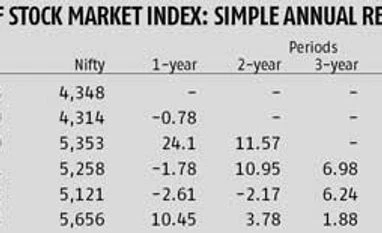
The common grouse of equity investors has been their portfolio has not performed up to the mark. In the analysis below, an attempt is made to find out the performance in case a person had invested at various time intervals in say equity index Nifty.
For the benefit of investors we have tracked the performance on a relative basis for various time periods. As can be seen from the above table, if you had invested in the index five years back, your simple annual return would have been just 6.02 per cent for the five year period. In case you had invested three years back i.e. on 20th June 2010, your simple return would have been only 1.88 per cent. However if you had invested last year, the return would have been 10.45 per cent for one year.
Most of the equity investors can take solace from the above table that the stock market has not performed as per expectation. So in case you have seen your portfolio is not performing or is in negative, there should not be much cause for worry.
The process of measuring the performance and monitoring the progress of the portfolio as well as the subsequent actions to fine tune the portfolio if needed requires an investor to follow a well thought out strategy. There is no ready to use solution to remedy any non-performance of investments. However it is important to always have an alternate plan in case your original investment does not provide desired results.
The writer is a freelancer

 "When your investments don't work out...")


 Connect with us on WhatsApp