Aam Aadmi Party works on national manifesto
Invites inputs from industry bodies and many others, as part of plan to spread wings in 2014; wants ideas on decentralisation, job growth
Somesh JhaShine Jacob New Delhi With the Lok Sabha election knocking, the Aam Aadmi Party (AAP) that stormed into power in Delhi is seeking the help of industry bodies, environmentalists, economists, policy makers and people from the unorganised sector to prepare its national manifesto, set to be out by March.
According to party sources, it asked the Confederation of Indian Industry (CII) for suggestions. Sources in AAP also say they’d like to take the help of Kiran Mazumdar-Shaw, chief of Biocon Industries, in the area of agriculture. And, of former Infosys chief financial officer V Balakrishnan for suggestions on information technology. AAP leaders are also in touch with environmentalist Medha Patkar. In all, AAP has incorporated 31 groups with around 115 members to work on policy aspects of the manifesto. It is also in the process of setting up a coordination team to finalise a national road map.
“We are taking inputs from diverse sources. In other parties’ manifestos, it is more about the market versus state economics. We would look to adopt a decentralised approach, with community-based economics,” said Atishi Marlena, a party member involved in this process.
CII sent some suggestions, as part of an industrial manifesto meant for all political parties. Interestingly, some of the suggestions it sent were contrary to the party’s core view. This included the chamber's pitch for easing foreign direct investment (FDI) norms. CII’s suggestions included an aim to increase these inflows to five per cent of global FDI by 2017 from 1.8 per cent now.
“As far as FDI is concerned, one needs to ensure there are checks and balances, which we lack currently,” said another AAP member who is part of the manifesto formation.
CII has called for implementation of a Goods and Service Tax, a Direct Taxes Code and creation of a Land Bank Corporation, to push economic growth. It also suggested steps in health care, education and skill development, employment, infrastructure and manufacturing sectors. Meanwhile, the party said unique taxation is a complex process and one of the key concerns of the party, adding that before the party forms some conclusion on the matter, it had extended their hands to some senior level economists to weigh its pros and cons.
Though the Biocon chief declined being associated with the manifesto team of the party, she told Business Standard, “AAP stands for pro-business and also professes honest business. They have a proper stand on taxation issues, administration, inflation and sectors like power. One should give them enough time before judging.”
AAP says its vision is for huge focus on the manufacturing sector but interlinked with education policies. Targeting the common man, the focus would be on inclusive growth and in case of agricultural policy, farmers’ concerns would be a priority. Decentralisation, a prime area highlighted in the Delhi poll manifesto, will find its way in the national manifesto as well. There are to be ‘mohalla sabhas’ in urban areas, where people’s views on various issues in their area would be sought; in rural areas, gram sabhas are to be strengthened.
SWOT ANALYSIS AAP has incorporated 31 groups with around 115 members to work on the policy aspects of its manifesto
STRENGTHS - Connect with the middle class
- Composition from a cross section with no regional or caste bias
- Predominantly youth, without any baggage
- Ethos based on the anti- corruption plank
WEAKNESSES - Lack of administrative experience
- If it is slow in implementing policies, the patience of people will run out
OPPORTUNITY - Lok Sabha Polls 2014 – If Delhi’s performance can be replicated
- Can attract new voters by contesting in cities and play spoiler or even win significant seats
THREAT - Contesting the Lok Sabha polls may dilute the party’s focus
- Dealing with regional parties
- Established parties are well-funded. Will it have the monetary muscle?

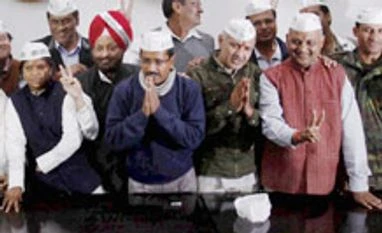 "Aam Aadmi Party works on national manifesto")


 Connect with us on WhatsApp