When the Bharatiya Janata Party’s (BJP’s) national council congregates in Delhi on January 11 and 12 for the last marathon sitting before the Lok Sabha election, more than an anodyne pep talk from the brass, members will look to dissipate the cloud of ambivalence over important issues.
They will seek clarity on matters that have concerned them since the party lost the Madhya Pradesh, Rajasthan and Chhattisgarh elections, which a senior functionary underplayed as a “setback but not so severe that we cannot overcome”. Others weren’t upbeat. “The loss was a bigger blow than we had imagined,” said a party source.
BJP members want the leadership to spell out the Centre’s stand on the Ram temple construction and if farm loans should be signed away.
Those from the upper castes seek an unambiguous pronouncement on the Scheduled Caste and Scheduled Tribe (Prevention of Atrocities) Act, reservation in job promotion and an SC/ST quota in the lower judiciary, which Law Minister Ravi Shankar Prasad pitched for, because they fear the perception of an “excessive” policy tilt towards the “lower” castes might alienate the Brahmins and the Rajputs from the BJP as it did in the three Hindi-speaking states. They believe that the government’s vacillation and the ensuing confusion on these issues helped the Congress earn plaudits in the elections and thereafter.
“The Congress is driving the national agenda while the BJP is reacting. It has to reset the discourse,” said an office-bearer. He alluded to the ambiguity arising from the conflicting statements over farm loan waiver to stress the point that the BJP was “unsuccessful” in countering Congress President Rahul Gandhi’s daily dare to Prime Minister Narendra Modi to announce a unilateral remission.
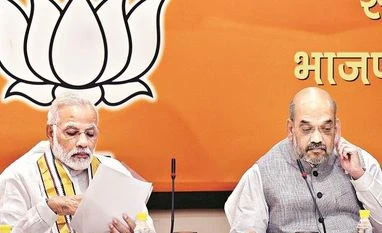
Modi and Amit Shah, the BJP president, met a number of times after the results were announced. But a long-drawn session of senior leaders held shortly thereafter did not elucidate the way forward to the Lok Sabha polls, except for Shah emphasising that the party organisation should become more robust.
“Modi and Shah are not happy with the BJP’s over-dependence on the leadership. They are saying use the popularity of our leadership to consolidate the organisation. Why else would he promptly engage in video conferencing with our workers?” asked a BJP functionary, who oversaw one of the recent elections. Modi’s interaction with the Puducherry audience experienced a blip when a trader, ostensibly selected as a BJP “sympathiser” after a screening, asked why the government was netting taxes without offering commensurate relief to the middle-class. The PM dodged the query.
The poll setback threw up four talking points: Whether the organisation should dominate a government or contrariwise, privileging Hindutva over development, relying excessively on personalities and under-projecting issues and policies, and conflating local strategies with a national campaign.
Different views were heard on the organisation’s role. An office-bearer who was involved with electioneering in Madhya Pradesh said: “It’s up to the organisation to win or lose an election. If a government works well, the organisation has to match correspondingly. In MP, the elections became CM-centred and not party-centred. The CM said we have done this and that for people as if it was a favour. The workers asked, where were we in all this? ”
A BJP ideologue’s opinion was, “Too much is being made of the organisation. Creating a favourable ambience is the key. What was the organisation we had when we swept the Tripura polls? The BJP and the Centre will have to create the right atmospherics by addressing the grievances of farmers and traders because, in MP and Chhattisgarh, the rural swing away from the BJP had a knock-on effect in the urban clusters.”
On the polemics over Hindutva and development, the preponderant view was that “vikas” and “good governance” should be prioritised over Ayodhya. “Those who want a Ram temple are committed voters. If they’re upset with the BJP, they will stay away but won’t vote the Opposition. The important thing is to woo the fringe voters by confronting the Congress squarely on the Rafale deal and hammering away at the scams the Congress governments have done. This way, we can create a larger sense of Modi giving a cleaner government,” a source said.
While there are no two thoughts over Modi remaining the BJP's/National Democratic Alliance’s “mascot”, the Rashtriya Swayamsevak Sangh has asked the BJP to “resist the temptation” of converting the 2019 battle into a presidential-style election like in 2014. “In 2014, we fought on a clean slate and went the full hog (against the Congress). Now Modi is saddled with accountability and liabilities. The BJP will have to calibrate the use of Modi,” a source said. Senior minister Nitin Gadkari’s tangential messages to Shah, suggesting he should account for the reverses, could not have come at a more inopportune moment because, in the BJP, Gadkari is often heard speaking for the Sangh.
Moreover, Shah is regarded as a Modi surrogate.
Lessons for BJP brass
The leadership needs to be cautious
A greater sensitivity to stirrings on the ground
Stop fighting state elections on national issues
Craft local strategies for the 543 Lok Sabha constituencies and run a national campaign
n Play up stability and good governance as a counterpoint against an “unwieldy” Congress-led “mahagatbandhan”
Harp on the Congress’s “corrupt” DNA
Debate on whether to make the Lok Sabha battle into a Narendra Modi vs Rahul Gandhi duel
On Ayodhya, let law take its course but put forth the government’s case forcefully before the Supreme Court
Do more for farmers and small traders to offset the negatives of the agrarian distress, GST
Make BJP cadre stakeholders, instead of adjuncts in governance
Involve state leaders instead of running the show from Delhi
Reset social media strategy to be on a par with the Congress’s new tactics
Stitch up local alliances fast; Bihar is done, the next focus will be on Uttar Pradesh where allies — the Suheldev Bharatiya Samaj Party, the Apna Dal (Sonelal) — have upped the ante on seat-sharing