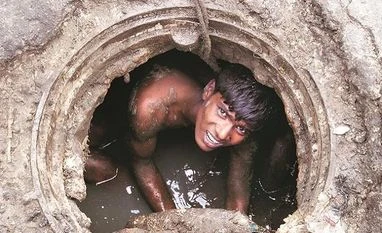
Data discrepancy obstructing rehabilitation of manual scavengers

Govt introduced the Self Employment Scheme for Rehabilitation of Manual Scavengers (SRMS) in 2007 to aid the rehabilitation of 'former' manual scavengers transitioning to other occupations

manual scavenging, manual scavengers, drainage, sewage
Finance Minister Nirmala Sitharaman has reduced the budget allocation for the SRMS in February by 9% to Rs 100 crore for FY22
Indiaspend
2 min read Last Updated : Mar 21 2021 | 9:01 PM IST
India banned and criminalised manual scavenging in 1993, and 20 years later, the Prohibition of Employment as Manual Scavengers And their Rehabilitation Act, 2013 (PEMSR Act, 2013), expanded the scope of rehabilitating manual scavengers (over 95 per cent are Dalits) and their dependents by providing for cash assistance to a member of the household, voluntary skill development training, capital subsidy and concessional loans, and scholarships for children. It also mandated the formation of central and state-level committees to monitor and coordinate the implementation of the Act.

The Department of Social Justice and Empowerment introduced the Self Employment Scheme for Rehabilitation of Manual Scavengers (SRMS) in 2007 to aid the rehabilitation of 'former' manual scavengers transitioning to other occupations. The Centre provides 100% funds for the scheme, which is implemented by the National Safai Karamcharis Finance and Development Corporation. Finance Minister Nirmala Sitharaman has reduced the budget allocation for the SRMS in February by 9% to Rs  100 crore for FY22.


"Persons released from manual scavenging should not have to cross hurdles to receive what is their legitimate due under the law," the Supreme Court had noted in 2014.  Rehabilitation is riddled with obstacles and hurdles, say former manual scavengers, activists and other stakeholders. For one, multiple data surveys and associated data discrepancy on the number of manual scavengers have complicated the process of identification and rehabilitation. 


One subscription. Two world-class reads.

Already subscribed? Log in

Subscribe to read the full story →
*Subscribe to Business Standard digital and get complimentary access to The New York Times

Smart Quarterly

₹900

3 Months

₹300/Month

SAVE 25%

Smart Essential

₹2,700

1 Year

₹225/Month

SAVE 46%
*Complimentary New York Times access for the 2nd year will be given after 12 months

Super Saver

₹3,900

2 Years

₹162/Month

Subscribe

Renews automatically, cancel anytime

Here’s what’s included in our digital subscription plans

Exclusive premium stories online

  • Over 30 premium stories daily, handpicked by our editors

Complimentary Access to The New York Times

  • News, Games, Cooking, Audio, Wirecutter & The Athletic

Business Standard Epaper

  • Digital replica of our daily newspaper — with options to read, save, and share

Curated Newsletters

  • Insights on markets, finance, politics, tech, and more delivered to your inbox

Market Analysis & Investment Insights

  • In-depth market analysis & insights with access to The Smart Investor

Archives

  • Repository of articles and publications dating back to 1997

Ad-free Reading

  • Uninterrupted reading experience with no advertisements

Seamless Access Across All Devices

  • Access Business Standard across devices — mobile, tablet, or PC, via web or app

Topics :Manual scavengersSupreme Courtwelfare schemesDalits

Next Story