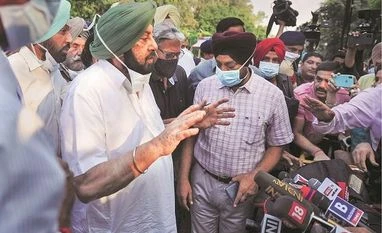
In the end, Amarinder Singh’s was the most unceremonious of all exits. What was to be a churning turned out to be an implosion culminating in a coup of sorts initiated a couple of years ago by former Bharatiya Janata Party (BJP) member Navjot Sidhu. After resigning as CM, Amarinder vented his spleen at Sidhu, describing him as an “incompetent, disastrous, dangerous, unstable, anti-national” character dilly-dallying with the Pakistanis, including their army chief.
Amarinder’s exit was perhaps evident when a three-member committee of the Congress high command submitted its report on the infighting and dismal state of affairs in the party’s Punjab unit in July. A member of that committee said that five stinging issues stoked wide-ranging dissent against Amarinder among his partymen.
First, there was a perception that Amarinder was too involved in buttressing his own brand and had been inactive as partyman for the past four-and-a-half years at the helm. There were indications that nine years in power had turned Amarinder into a regional satrap undermining the central leadership’s authority — something unacceptable to the Gandhi family.
Second, he had failed to implement the party’s 2017 manifesto in letter and spirit with many election promises remaining unfulfilled.
Third, as the top Congress leader in the state, Amarinder was riding shotgun to the very political rivals he was supposed to hound and make electorally irrelevant. Of particular concern was his inability to nail the Badals and their extended family in various cases involving corruption, narcotics, and blasphemy. This was hurting influential local Congress leaders who were baying for the Badals’ blood after being hounded by them during the Akali tenure.
Fourth, few chief ministers were as active as Amarinder in regularly communicating with the Modi government. He was being perceived as more receptive to Prime Minister Narendra Modi and Defence Minister Rajnath Singh on administrative issues than his own Cabinet or the party leadership. Last, his grassroots outreach had hit rock bottom and he was regarded as lacking a future vision for the party. The obsession with his own stellar performance in steering the party to multiple wins in state, national, and local body elections was stymying the party’s growth and the emergence of pedigreed alternatives to 80-year-old Amarinder, the committee member said.
“You can be the tallest leader of the Congress in a state. That is inconsequential. He isn’t a vote-catcher. Personal aura is of no use if it doesn’t translate to votes for the party,” the member said.
Amarinder’s resignation can have three repercussions for the Congress in Punjab, which goes to the polls early next year. First, it emboldens the embattled Shiromani Akali Dal (SAD) and a resurgent Aam Aadmi Party (AAP) in the state.
In the 2017 polls, the AAP emerged as the principal Opposition party, bagging two more seats than the SAD. Out in the wilderness since 2012, the Akalis are yet to gain traction despite making an early start for the 2022 polls through candidate announcements and grassroots mobilisation. The Badals’ attempts to be seen as champions of the farmer agitation has met with resistance from farmer bodies. Many still perceive them as being in cahoots with the BJP while the farm laws were drafted.
“Although he has promised a Sikh CM, Kejriwal is still projecting himself as the face of the AAP in Punjab. A non-turbaned, non-Sikh Haryanvi like Kejriwal is unlikely to yield dividends for his party. Nonetheless, the biggest beneficiary of all this could be the AAP,” said Ashutosh Kumar, professor of political science at Panjab University.
Second, Sidhu’s elevation as party president and his internecine diatribes that preceded Amarinder’s exit added to the party’s anti-incumbency woes. His resignation could be the final nail in the Congress coffin for 2022. While the Akalis and the AAP are already in election mode, the Congress is now left grappling with the possibility of Amarinder gravitating to an opponent or splitting the party.
The former CM has been tight-lipped about his intentions but told the media that “all options were open” when asked about his affinity to the BJP. Amarinder’s public rants against Sidhu raising his proximity to Pakistan PM Imran Khan and army chief General Qamar Bajwa remains a threat. “No Punjabi would buy the argument that the Pakistanis are behind the drug problem in Punjab. National security is not an issue in the state. Painting Sidhu as anti-national would have limited resonance with the electorate,” said Kumar.
Lastly, while the Gandhi siblings have had their way with Amarinder’s ouster, the future of the party under the temperamental Sidhu’s leadership is uncertain. He had threatened the Congress with untoward consequences if not given the freedom to operate without inviting the chagrin of Priyanka Gandhi, whose affections he is known to command. His clean image, oratory skills, consistent espousing of pertinent issues, and a Congress family background are factors working in his favour. But only time will tell whether Sidhu was the Trojan who set the Congress on fire or resurrected it in a new avatar after demolishing Punjab’s tallest Congressman.

 "Has Navjot Singh Sidhu driven final nail in the coffin for Punjab Congress?")












 Connect with us on WhatsApp