It is your farmer versus my farmer. In the battle to look more rural friendly, ruling Bharatiya Janata Party (BJP)-headed NDA and the Congress-led UPA are locked in a fierce war of words to show their sympathy with India’s over 130 million farmer-families.
While, the BJP is claiming credit for enhancing the compensation for crop loss due to natural calamities, renaming of the union agriculture ministry and starting a host of programmes and schemes that would fundamentally alter the country’s agriculture, opposition Congress doubts the government’s claims because of attempts to amend the land acquisition Act and nominal hike in the minimum support price (MSP) of major farm commodities, particularly rice and wheat, since 2014.
On Sunday Congress vice-president Rahul Gandhi, stepped up the attack on the Narendra Modi government, terming it anti-farmer and pro-corporate. He was addressing a farmer’s rally, organised by the Congress, the second such gathering of growers since the party lost power in 2014. The rally was held to celebrate the party’s success in stalling amendments to the controversial Right to Fair Compensation and Transparency in Land Acquisition, Rehabilitation and Resettlement Act, 2013, commonly known as the land Act.
The NDA government tried to alter the Act, which was passed during the previous UPA government, on the request of state chief ministers, who found land acquisition difficult under the new law. However, the Congress strongly opposed the amendments and alleged that the ruling NDA was trying to amend the provisions to ‘snatch’ land from growers. The BJP-led government finally decided to drop the proposed changes, and instead decided to include 13 other central Acts within the provisions of the land Act to enable buyers to get the same benefits. Prime Minister Narendra Modi in his radio address — Mann ki Baat — acknowledged that the ordinance to amend the Act will lapse on August 31 in the interest of the farmers.
The NDA government, which came to power last year on the back of a massive public support in favour of Prime Minister Narendra Modi had been at odds to explain the sudden dip in confidence in rural India because of a variety of reasons. A sharp drop in prices of major farm products, nominal increase in MSP of wheat and rice, massive damage to standing rabi crop in 2015, which followed a drop in kharif production have contributed in building the so-called negative perception about the government in some parts of rural India. The amendments to the land Act also played its part in building that perception.
A spurt in farmer suicides due to crop loss was latched on by the Opposition as being signs of rural distress. A look at the last years of the the previous UPA regime and the initial 16 months of NDA suggests that both the periods have been rather work in progress. UPA under the Prime Ministership of Manmohan Singh embarked on one of the massive increases in MSP of wheat and rice till 2012-13.
In fact, after that period, the hike in MSP of wheat and rice has been rather muted, but that of oilseeds and pulses has been raised significantly. The reason given was to give a clear signal to farmers to shift from surplus wheat and rice to more in-demand pulses and oilseeds. This would in the long-run also save valuable foreign-exchange as India is one of the largest importers of pulses and oilseeds in the world. The Modi government on its part not only increased the compensation for crop loss by over 50 per cent, but also lowered the eligibility criteria for such compensation, which in turn, is expected to provide direct benefit to millions of growers.
It has also embarked on an ambitious programme to provide irrigation facilities to all farm lands by amalgamation of all major existing schemes and providing new thrust to them. It is in the process of launching a new crop insurance scheme and embarked on a massive countrywide programme to provide soil-health cards to all farmer families across the country in a time-bound manner. It has also started a programme to electronically integrate all mandis through an electronic platform. Many of the steps taken by the NDA government are somewhat meant to provide long-term solution to the farm crisis, but how far they can give immediate relief to growers remains to be seen.

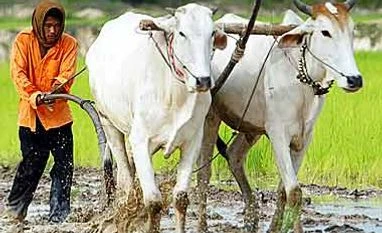 "NDA, UPA vie to woo farm sector")


 Connect with us on WhatsApp