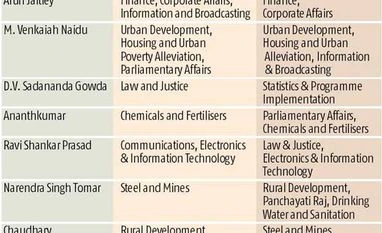
Prime Minister Narendra Modi on Tuesday carried out major changes in the portfolios of his key ministers and dropped five ministers. He also expanded his council of ministers by inducting 19 ministers of state.
The five ministers given the boot had all handled social sector portfolios.
The PM’s signal to his ministerial colleagues was clear — he wants better performance from his ministers manning social sector portfolios. The social sector constitutes the core of Modi’s Budget priority towards “gaon” (villages), “garib” (poor) and “kisan” (farmers).
The likes of Piyush Goyal, coal and power minister, Dharmendra Pradhan, Oil Minister, considered to be performers, were not given the anticipated Cabinet ranks.
With the addition of the 19 MoS, the Union council of ministers now has 78 members. It is one of the largest of recent times.
The Congress-led United Progressive Alliance government’s Cabinet had started with 50 ministers and, at its fattest, was also 78-member strong.
The Constitution mandates that the council of ministers, including the PM, cannot be more than 15 per cent of the Lok Sabha strength, which comes to 82.
In its manifesto for the 2014 Lok Sabha, the Bharatiya Janata Party had promised “maximum governance, minimum government”. The Modi government had teed off with a 46-member ministry, which burgeoned to 66 by November 2014.
Government sources claimed the expansion will bring “experience, expertise and energy” to Modi’s team; most of the newcomers are experienced. Of the 19 inducted on Tuesday, as many as 11 are above 60 years of age, and three are above 55. Only five ministers are below 50. Moreover, several of them have served as ministers in the Union government or state governments.
Sources said the PM wants such experienced ministers to assist in spurring the Cabinet-ranked ministers in some of the non-performing departments. In end-June, the PM had reviewed the performance of all ministers and departments in achieving the targets of the three Budgets of his government and listed the laggard ministries.
(MINISTERS OF STATE) Of the 19, as many as six or nearly a third are from the Rajya Sabha. This further skews the tilt towards the Upper House in Modi’s council of ministers.
Currently, nearly a fourth of the council of ministers comprises Rajya Sabha members.
In another departure, the rule that no ministers above 75 years of age will be accommodated has been diluted. Sources said the BJP couldn’t have afforded to drop Kalraj Mishra, an important Brahmin leader of Uttar Pradesh, with elections due in that state by early 2017. Minorities Affairs Minister Najma Heptulla has also survived the rejig.
The expansion has been done with a clear eye to the forthcoming elections to Uttar Pradesh, Punjab, and Uttarakhand with five Dalits, two from minorities and several OBCs inducted.
Of those who have quit, Panchayati Raj minister Nihal Chand, an MP from Rajasthan, was not only considered a non-performer who spent little time in Delhi but the party was embarrassed because of an old charge of alleged rape against him.
The government has kept the caste balance by including Arjun Ram Meghwal, also a Dalit MP from Rajasthan, in the Cabinet. Meghwal is a retired Indian Administrative Service (IAS) officer.
Agriculture and farmers’ welfare minister Mohanbhai Kalyanjibhai Kundariya was also considered a non-performer, as was tribal affairs minister Mansukhbhai Dhanjibhai Vasava. Both are out of the council of ministers.
Another one who has been given the leave is water resources river development and Ganga rejuvenation minister Sanwar Lal Jat, who has been unwell. Jat couldn’t travel across India to spread the message of the government’s two years’ performance during the “Vikas Parva” because of ill health.
Jat is a Lok Sabha MP from Ajmer in Rajasthan. Kundariya represents the Rajkot Lok Sabha seat and Vasava is from Bharuch seat, both in Gujarat.
Among the new members, there are three each from Rajasthan and Gujarat. From Rajasthan, the new ministers are Meghwal, C R Chaudhary and P P Chaudhary. New ministers from Gujarat are Parshottam Rupala, Jaswant Singh Bhabhor and Mansukh Lal Mandaviya.
Bhabhor is a tribal leader, Rupala an OBC Kushwaha while Mandaviya is from the Patel community.
Mandaviya’s selection is to assuage the community that has been demanding job quotas. The BJP fears its Patel support base is slipping away.
Vijay Goel, while a political leader of Delhi, is a Rajya Sabha member from Rajasthan.
Human resource development minister Ram Shankar Katheria, who has also been dropped, is an MP from Uttar Pradesh’s Agra Lok Sabha seat. He is a Dalit.
Katheria has been in news for his controversial statements that have embarrassed the government. His equation with HRD Cabinet Minister Smriti Irani has been prickly.
Of the new ministers, nine have post-graduate degrees and seven are graduates. Of these, seven have law degrees, two are business graduates and one is a doctor.
Key takeaways from cabinet expansion
1. Ministers with portfolios concerning economic sectors not touched; but reshuffle of portfolios expected
2. All five sacked ministers from social sectors which constitutes the core of Modi’s budget priority to ‘Bharat’’s ‘gaon’ (villages), garib (poor) and kisan (farmers)
3. Unexpected elevation of Prakash Javadekar, other performers like Piyush Goyal and Dharmendra Pradhan not touched
4. Age profile of the council of ministers has gone up
5. Representation of the Rajya Sabha in the council of ministers increases
6. One of the biggest cabinets of recent times; constitution mandated limit is 82 and current cabinet now (including the PM) has 78
7. No ministers above 75 criteria diluted, with Najma Heptulla and Kalraj Mishra keeping their jobs
8. More representation to minorities, dalits, OBCs with an eye on assembly polls to five states, including UP and Uttarakhand
9. Appointment of experienced Ministers of States as juniors to non-performing ministers to spur them
How the Cabinet has grown
May 26, 2014: 46 member council of ministers, including the PM, sworn in. Apart from the PM, it included 23 cabinet ministers, 10 MoS with independent charge and 12 MoS (Gopinath Munde passed away within days)
November 9, 2014: Council of ministers expanded to include 21 new ministers – 4 cabinet, 3 MoS with independent charge and 14 MoS. It now had 66 members (Sarbananda Sonowal and Rao Saheb Danve Patil later quit)
July 5, 2016: 19 MoS sworn in, including replacements for two who had quit; five MoS sacked; Strength of the council, including the PM, is 78

 "Modi drops five ministers, inducts 19")


 Connect with us on WhatsApp