Putative SP-BSP unity will be tested in the next few months

Mayawati's Rajya Sabha term ends in April 2018, and she will need the SP to get re-elected
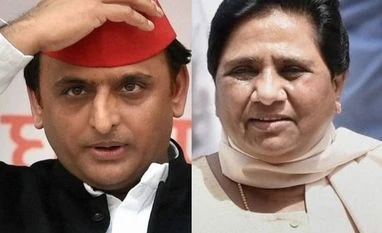
akhilesh, mayawati
Akhilesh Yadav and Mayawati
Archis Mohan New Delhi
Last Updated : Mar 30 2017 | 4:41 PM IST
The recent bonhomie between Samajwadi Party (SP) and Bahujan Samaj Party (BSP) members in the Rajya Sabha has raised hopes of a united front against the Narendra Modi-led Bharatiya Janata Party (BJP) in Uttar Pradesh in the 2019 Lok Sabha elections.

But this putative unity of the Uttar Pradesh (UP) archrivals will be tested next year in the Rajya Sabha elections, when BSP chief Mayawati’s term ends, and before that in the by-poll for the Gorakhpur Lok Sabha seat, which has fallen vacant after its sitting member Adityanath Yogi has quit and sworn in as the UP chief minister.

As a rule, the BSP does not contest by-elections. The SP and Congress are likely to field a joint candidate, but it would be interesting to watch if the BSP chief and her party campaign for such a candidate.

It would be the SP’s turn to return the favour by early 2018. Mayawati’s Rajya Sabha term ends in April 2018. The BSP has a mere 19 seats in the UP Assembly. Even if the Congress, with its 7 seats, supports her, the number would be insufficient for her to get re-elected to the Rajya Sabha. She can get elected to the Rajya Sabha only if the SP, with 47 seats in the UP Assembly, asks its legislators to vote for Mayawati.

In the last couple of days, BSP and SP members have together trooped into the well of the House to disrupt proceedings as they protested against the government’s failure to fill vacancies in the statutory bodies, like the Scheduled Caste and OBC commission. The Congress and Janata Dal (United) supported them. 

The SP and BSP have found some of their vote bank shifting to the BJP in the 2014 Lok Sabha elections, and again in the 2017 Assembly polls in UP.

In the UP Assembly polls, the BJP got 39.7 per cent votes, and, together with its smaller allies, a vote share of 42 per cent.

The SP bagged 21.8 per cent and BSP 22.2 per cent, while the Congress received 6.2 per cent. Together, this comes to 50.2 per cent. Such an alliance, or so some in these parties believe, can defeat the Modi-led BJP in 2019.

However, there are others in the Opposition ranks who believe that just the aggregation of votes cannot defeat the BJP, and the need is to build a new narrative on the ground with its basis in people’s movements.

One subscription. Two world-class reads.

Already subscribed? Log in

Subscribe to read the full story →
*Subscribe to Business Standard digital and get complimentary access to The New York Times

Smart Quarterly

₹900

3 Months

₹300/Month

SAVE 25%

Smart Essential

₹2,700

1 Year

₹225/Month

SAVE 46%
*Complimentary New York Times access for the 2nd year will be given after 12 months

Super Saver

₹3,900

2 Years

₹162/Month

Subscribe

Renews automatically, cancel anytime

Here’s what’s included in our digital subscription plans

Exclusive premium stories online

  • Over 30 premium stories daily, handpicked by our editors

Complimentary Access to The New York Times

  • News, Games, Cooking, Audio, Wirecutter & The Athletic

Business Standard Epaper

  • Digital replica of our daily newspaper — with options to read, save, and share

Curated Newsletters

  • Insights on markets, finance, politics, tech, and more delivered to your inbox

Market Analysis & Investment Insights

  • In-depth market analysis & insights with access to The Smart Investor

Archives

  • Repository of articles and publications dating back to 1997

Ad-free Reading

  • Uninterrupted reading experience with no advertisements

Seamless Access Across All Devices

  • Access Business Standard across devices — mobile, tablet, or PC, via web or app

Next Story



