Sitaram Yechury, Prakash Karat and the legacy of Harkishan Singh Surjeet

In 1996, and again in 2003-04, Surjeet played a key role to bring regional parties, the Congress and Left parties together to form a coalition government at the Centre
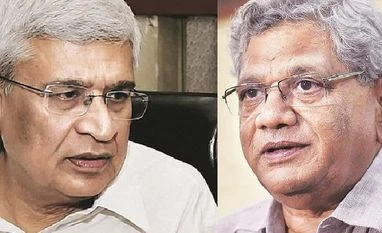
Prakash Karat (left); Sitaram Yechury
Archis Mohan New Delhi
Last Updated : Jan 25 2018 | 5:45 PM IST
At the heart of the current infighting in the Communist Party of India (Marxist) is the legacy of Harkishan Singh Surjeet, and who from among former party chief Prakash Karat and current chief Sitaram Yechury, would become its true inheritor in the run-up to the Lok Sabha elections.

In 1996, and again in 2003-04, Surjeet played a key role to bring regional parties, the Congress and Left parties together to form a coalition government at the Centre to keep the Bharatiya Janata Party (BJP) at bay.

In the Congress and other regional parties, there is a consensus that such a moment beckons, but the trust deficit between regional leaders remains a challenge. It requires a Surjeet kind of a figure to play the ‘honest broker’.

Trinamool Congress leader Derek O’ Brien told Business Standard recently that his party, and its leader, West Bengal Chief Minister Mamata Banerjee, will be the “catalyst” for opposition unity.

Since demonetisation on November 8, 2016, Banerjee has tried to take the lead in rallying together opposition parties, but also allies of the BJP, like the Shiv Sena, against the Narendra Modi government.

But Banerjee and her party leaders have their own ambitions. This is unlike the CPI(M), which as Yechury says, has the “intellectual property right over outside support”.

Both, in the United Front government of 1996 to 1998, and the Congress-led UPA 1 from 2004 to 2008, the CPI (M) provided outside support to the governments. On both occasions, Surjeet was trusted as he had no personal stakes involved, neither did his party was expected to demand ministerial berths.

That he had known Congress and regional party politicians for several years, Surjeet was an effective ‘honest broker’ between a mutually distrustful Congress leadership, a Lalu Prasad, a Mayawati, an MK Karunanidhi, an HD Deve Gowda and several other regional leaders.

The CPI (M) is no longer the force that it was in 1996 or 2004. But it continues to punch above its weight as its top leadership is still considered largely incorruptible, with no personal axe to grind and proficient at shaping an ideological narrative for the forthcoming fight against the BJP-Rashtriya Swayamsevak Sangh (RSS) combine.

At a time when the Congress party under its new chief Rahul Gandhi is attempting to shape its narrative around farm distress and joblessness, the CPI (M) and CPI are the only parties perceived to have raised these issues consistently and uncompromisingly.

The All India Kisan Sabha (AIKS), a CPI (M) affiliate, has led recent farmer protests in several states. “The mainstream media might not recognize our contribution, but we have provided the spine to the farmer movement,” AIKS leader Hannan Mollah says. Similarly, the trade union protests couldn’t have been successful without trade unions like the CITU and AITUC.

Over the years, and particularly since 2015, the CPI (M) has also provided strong support to Dalit movements across the country. Bharipa Bahujan Mahasangh chief and Dalit leader Prakash Ambedkar says only the left can play the role of a catalyst, not the Congress. “The Congress has still not come out of its attitude of ‘sultanate’. The Congress is not ready to listen or accommodate, as we experienced in Gujarat, or the story would have been different,” Ambedkar told Business Standard.

Moreover, Ambedkar said, the Congress continues to lack the credibility in the eyes of the people. “Only the Left can play this role. They have a strong presence in several states, but also right kind of manoeuvrability. They might have heavy stakes in Bengal and Kerala, but elsewhere they can be facilitators, both their leaders and party units,” Ambedkar said.

From April 18 to 22, the CPI (M) will hold its party conclave, which takes place once in three years, in Hyderabad. At the conclave, it will decide its political line for the next three years, which it will also shape its electoral line. Yechury’s three-year term as party chief ends then, and he will be up for re-election.

Indications are the Karat camp is likely to mount a challenge. Whether Yechury continues to hold sway, or somebody with proximity to Karat gets elected, could depend on the events in the next two months, including the CPI (M)’s performance in Tripura assembly polls.

Over the weekend, the party central committee voted by 31 to 55 votes to reject Yechury’s draft political resolution. Karat’s draft will now be circulated among district units and forwarded for a vote in the conclave.

While Yechury’s draft keeps the door open for the party to have an electoral understanding with the Congress, Karat’s draft specifically rules it out. Even Communist Party of India (CPI), the CPI(M)'s ally, doesn't agree with Karat's draft.

CPI leader D Raja said his party is of the view that the Congress will need to be an integral part of a broad secular democratic platform. “The objective will be to defeat the BJP. Electoral alliances will vary from state to state,” he said. The CPI will make public its draft political resolution in February,

On Thursday, in an editorial of CPI (M)'s mouthpiece 'People's Democracy', Karat responded to some of the criticism he has faced in recent days for defeating Yechury's draft. Ever since the central committee vote, Karat has been accused of toeing BJP chief Amit Shah’s agenda.

While Karat denied that the fight was a personal one between Yechury and him, or factional between the party's Bengal versus Kerala units, the editorial reinforced that the difference between Yechury’s and his draft was of nuance.

In the 919-word editorial, Karat didn’t mention the Congress party even once, and clearly enunciated the CPI (M)’s commitment to “counter” the “threat” posed by the BJP-Rashtriya Swayamsevak Sangh (RSS).

In the polit bureau meeting in Kolkata, Yechury had pointed out the similarities in the two drafts and asked what was the “agenda” that many of them opposed his draft.

Interestingly, in the editorial Karat harped on how the polit bureau and central committee “had intense discussions on formulating an effective political line which can counter this threat” of BJP-RSS, a tactical line which can fight the BJP politically, ideologically and mobilise the people to defeat the Modi government.

Karat said the interest and concern among people about the political line to be adopted by the CPI(M) stemmed from the widespread desire of secular and democratic-minded people that an effective unity be forged to take on the BJP. He assured that the Hyderabad party conclave will meet this concern.

In 2004, the Left and the Congress had reached an electoral understanding. They fought each other across India, including in Bengal and Kerala, but had electoral understanding in Tamil Nadu and Andhra Pradesh. More importantly, several leftist organisations had contributed on the ground to build a narrative against the 'India Shining' campaign, while Surjeet played an important role in helping then Congress president Sonia Gandhi to stitch an alliance with regional parties.

One subscription. Two world-class reads.

Already subscribed? Log in

Subscribe to read the full story →
*Subscribe to Business Standard digital and get complimentary access to The New York Times

Smart Quarterly

₹900

3 Months

₹300/Month

SAVE 25%

Smart Essential

₹2,700

1 Year

₹225/Month

SAVE 46%
*Complimentary New York Times access for the 2nd year will be given after 12 months

Super Saver

₹3,900

2 Years

₹162/Month

Subscribe

Renews automatically, cancel anytime

Here’s what’s included in our digital subscription plans

Exclusive premium stories online

  • Over 30 premium stories daily, handpicked by our editors

Complimentary Access to The New York Times

  • News, Games, Cooking, Audio, Wirecutter & The Athletic

Business Standard Epaper

  • Digital replica of our daily newspaper — with options to read, save, and share

Curated Newsletters

  • Insights on markets, finance, politics, tech, and more delivered to your inbox

Market Analysis & Investment Insights

  • In-depth market analysis & insights with access to The Smart Investor

Archives

  • Repository of articles and publications dating back to 1997

Ad-free Reading

  • Uninterrupted reading experience with no advertisements

Seamless Access Across All Devices

  • Access Business Standard across devices — mobile, tablet, or PC, via web or app

Next Story


