Tamil Nadu governor's review meetings raise anger of opposition parties

The opposition parties in Tamil Nadu say that this is a ploy of the central govt
Banwarilal Purohit
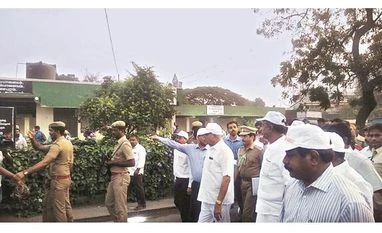
Tamil Nadu Governor Banwarilal Purohit inspecting a public toilet in Coimbatore as part of the Swachh Bharat mission
Gireesh BabuT E Narasimhan Chennai
Last Updated : Dec 03 2017 | 10:16 PM IST
The constitutionality of some actions taken by Banwarilal Purohit as governor of Tamil Nadu is being questioned by political parties. This is acquiring an additional dimension because the chief minister of neighbouring Puducherry, V Narayanasamy, has flayed the alleged interference in his work by Lieutenant Governor Kiran Bedi.

The controversies related to the role of the governor in Tamil Nadu have been a talking point for some time, from when the previous governor, C Vidyasagar Rao, was missing in the state during crucial phases following the death of 

J Jayalalithaa, who was chief minister, in December last year. For example, he was absent when AIADMK leader V K Sasikala staked claim to form the government, till a Supreme Court order sent her to jail.

The latest controversies started when Purohit, who took charge recently, did a review meeting with district administration officials in Coimbatore, along with Minister for Municipal Administration S P Velumani. With various political parties raising their voice against this, the next day he led a clean-up drive at a bus stand in the district and, according to reports, proclaimed that he would do review meetings in other districts, too.

DMK Working President M K Stalin and T T V Dhinakaran, a faction leader in the AIADMK, are in the forefront of criticism, alleging the Centre is trying to interfere in the state’s administration. Stalin said the governor’s move was part of the Bharatiya Janata Party (BJP)-led central government’s plans to seize the powers of the state government.

“A governor does not have the powers of a lieutenant governor (LG). The Central government is trying to rule the state through the governor because the current AIADMK government is weak,” he said. This would result in the formation of two power centres and lead to a collapse in administration, he said. 

Dhinakaran alleged the governor was acting in a manner similar to that of the LGs of Delhi and Puducherry. 

PMK leader Anbumani Ramadoss, too, is of the view that the governor had overstepped his remit. Like others, he also attacked the central government and Prime Minister Narendra Modi for this.

MDMK, another regional party, has decided to send Modi a copy of a letter the latter wrote in 2011 as chief minister of Gujarat, seeking an immediate recall of the then governor, Kamla Beniwal, from the state.

However, the government of Tamil Nadu is not against the governor conducting review meetings. Chief Minister Edappadi K Palaniswami said the governor was not interfering in the government’s affairs, adding he was only familiarising himself with the functioning of various departments. He alleged opposition parties were trying to create a rift within the government.

While the ruling Palanisami-O Panneerselvam faction says there is no rift within, AIADMK Rajya Sabha member V Maitreyan hinted at a possible rupture in the recently cemented understanding between the party’s two factions. 

The Panneerselvam faction is discontented because though “the understanding was to give party leadership to Panneerselvam and chief ministership to Palanisami”, the faction did not get adequate representation in the party. Maitreyan’s comment was welcomed by the leaders in the Dhinakaran faction, said sources. 

Some analysts allege the governor's action is contrary to the tenets of democracy. According to Article 167 of the Constitution, the chief minister is the one to update the governor on the decisions taken by the council of ministers related to the administration and legislation. While the governor may summon an official for an update on particular developments, conducting review meetings at district level is not a healthy sign of democracy, they say.

The governor, on his part, issued a statement that he had not exceeded his jurisdiction. In this, he had taken advice from legal experts. He had done similar meetings during his previous stint in Assam, he added.

With the turmoil continues, industry feels it is not getting the same attention it had received earlier. A chief executive officer of a leading company has said that unlike in the past, the government is not following up the industry proposals on investments.

One subscription. Two world-class reads.

Already subscribed? Log in

Subscribe to read the full story →
*Subscribe to Business Standard digital and get complimentary access to The New York Times

Smart Quarterly

₹900

3 Months

₹300/Month

SAVE 25%

Smart Essential

₹2,700

1 Year

₹225/Month

SAVE 46%
*Complimentary New York Times access for the 2nd year will be given after 12 months

Super Saver

₹3,900

2 Years

₹162/Month

Subscribe

Renews automatically, cancel anytime

Here’s what’s included in our digital subscription plans

Exclusive premium stories online

  • Over 30 premium stories daily, handpicked by our editors

Complimentary Access to The New York Times

  • News, Games, Cooking, Audio, Wirecutter & The Athletic

Business Standard Epaper

  • Digital replica of our daily newspaper — with options to read, save, and share

Curated Newsletters

  • Insights on markets, finance, politics, tech, and more delivered to your inbox

Market Analysis & Investment Insights

  • In-depth market analysis & insights with access to The Smart Investor

Archives

  • Repository of articles and publications dating back to 1997

Ad-free Reading

  • Uninterrupted reading experience with no advertisements

Seamless Access Across All Devices

  • Access Business Standard across devices — mobile, tablet, or PC, via web or app

Next Story



