The son rises in SP's Camelot

Akhilesh Yadav, the amiable crown prince, emerges from his father's shadow
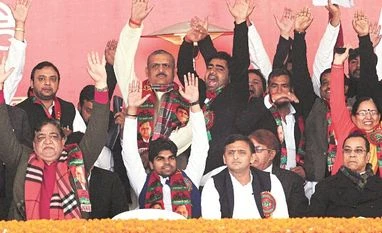
Akhilesh Yadav, UP, CM
Akhilesh Yadav
Radhika Ramaseshan New Delhi
Last Updated : Jan 09 2017 | 2:09 AM IST
Akhilesh Yadav debuted in Parliament as a Lok Sabha member in 2000, unsure of himself. Mulayam Singh Yadav, his father, forced him into politics on deciding the young man wanted to “do nothing but roam around the country” with wife Dimple, whom he married in 1999.

Mulayam pulled out all the stops to see Akhilesh through in a by-election from Kannauj in central Uttar Pradesh, where he was up against a formidable contender, Akbar ‘Dumpy’ Ahmed of the Bahujan Samaj Party. 

Mulayam also persuaded Akhilesh to take his oath in Parliament in a dhoti-kurta, reportedly against Akhilesh’s wishes. But, in introducing him to socialist associates like veteran Jaipal Reddy, Mulayam prefaced it with the mention that Akhilesh spoke fluent English. Illustrating Mulayam’s contradictory attitude towards a language he had assailed as the greatest curse on the country and the state when he was the CM in 1990.

That did not stop Mulayam from seeing English as a stepping board to success for Akhilesh. He put him in an English-medium institution, Dholpur’s Sainik School. Later, in the Sri Jayachamarajendra College of Engineering in Mysuru and finally in the University of Sydney for a postgraduate degree in environmental engineering.

Akhilesh was never seen in his father’s favourite attire thereafter. He spoke little in the Lok Sabha and gave an impression that he would never emerge from Mulayam’s shadow. 

The dynamics of the father-son relation transformed after Mulayam indicated  Akhilesh would be the political heir if the Samajwadi Party won the 2012 legislative assembly election in UP. Akhilesh was till then known as a street-fighter, who occasionally courted arrest when Mayawati was the CM. Now, he looked at governance and development seriously. He was particularly taken with the model of development adopted by Narendra Modi when the latter was Gujarat chief minister; he never spoke of it openly, as Modi was not kosher in the SP’s secular politics. Akhilesh often wondered to his confidants how Modi kept winning elections without indulging in populism and asked if he could do the same in UP.

Like Jayalalithaa and Nitish Kumar, he succumbed, too, to the political gains to be made from offering freebies like free laptops to students, loan waiver for farmers and unemployment doles. Akhilesh’s package was a winner in the 2012 elections, despite the fact that large parts of the state were power starved and the exchequer looked far from being robust.

As the CM, he changed track subtly and shifted the discourse of politics and governance from populism, casteism and communalism to development. Global investor summits, meant to re-brand UP from the boondocks to a resource-rich state that would be on the mend, were the order of the day. The Akhilesh government managed to draw investments, although objective observers believed he had oversold a state that direly lacked infrastructure, power and the mindset to get things going. The major investments came in the food processing sector but these got stymied because cold storages malfunctioned for want of power.  

Akhilesh’s pet obsessions were expressways and Metro rail projects that remain in different stages of completion at the end of his term. Part of the reason for the less-than-optimum delivery was because Akhilesh could not always save his picked officers. Mulayam tied his son’s hands more than once. The former’s favourite officer, Anita Singh, whom Akhilesh retained against his own wishes, functioned like a law unto herself at the Lucknow secretariat. The CM found her presence so irksome that he began functioning from his official residence.

He had his way when three years ago, he roped in an out-of-favour IAS officer, Navneet Sehgal, and gave him a host of responsibilities. Mulayam resented Sehgal because he was close to Mayawati. Akhilesh overruled his objections because he thought Sehgal would deliver on whatever he was mandated to do. 

There was one area where Akhilesh floundered and that was in keeping law and order normal and neutral. Mulayam and brother Shivpal Singh Yadav saw to it most of the police stations were controlled by Yadavs. Of Uttar Pradesh’s 1,526 police stations, it is estimated that 600 are under a Yadav. This means people from other castes, particularly Dalits, cannot approach them even to file a complaint.

One subscription. Two world-class reads.

Already subscribed? Log in

Subscribe to read the full story →
*Subscribe to Business Standard digital and get complimentary access to The New York Times

Smart Quarterly

₹900

3 Months

₹300/Month

SAVE 25%

Smart Essential

₹2,700

1 Year

₹225/Month

SAVE 46%
*Complimentary New York Times access for the 2nd year will be given after 12 months

Super Saver

₹3,900

2 Years

₹162/Month

Subscribe

Renews automatically, cancel anytime

Here’s what’s included in our digital subscription plans

Exclusive premium stories online

  • Over 30 premium stories daily, handpicked by our editors

Complimentary Access to The New York Times

  • News, Games, Cooking, Audio, Wirecutter & The Athletic

Business Standard Epaper

  • Digital replica of our daily newspaper — with options to read, save, and share

Curated Newsletters

  • Insights on markets, finance, politics, tech, and more delivered to your inbox

Market Analysis & Investment Insights

  • In-depth market analysis & insights with access to The Smart Investor

Archives

  • Repository of articles and publications dating back to 1997

Ad-free Reading

  • Uninterrupted reading experience with no advertisements

Seamless Access Across All Devices

  • Access Business Standard across devices — mobile, tablet, or PC, via web or app

Next Story



