Toeing Tikait line: 'Not sure' if BKU stays away from UP politics in 2022

The BKU had its first successful siege of Delhi in 1988 over low cane prices and upward revision of electricity and water rates
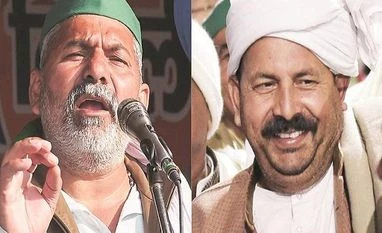
Rakesh Tikait, Naresh Tikait
While Rakesh Tikait is organiser and logistics head of the BKU, his brother Naresh is its president
Aditi Phadnis New Delhi
4 min read Last Updated : Feb 14 2021 | 8:30 PM IST
Gopi Kashyap, an office-bearer in the Bharatiya Kisan Union (BKU)’s youth wing, is not a kisan (farmer) at all. Nor is he a Jat. But he does belong to western Uttar Pradesh (Nithari village) and until recently, he was a dedicated supporter of the Bharatiya Janata Party (BJP).

“We sent Sharmaji (Mahesh Sharma, Union minister and Lok Sabha MP from the Gautam Buddh Nagar constituency) to Parliament twice. Now the very government we helped to form is telling us we are enemies of the nation!” Kashyap says incredulously.

He adds: “And what have they given us? You want to send your children to government schools, but facilities are so bad, you’re forced to send them to private schools: Even if you can’t afford it. Families I know have been ruined because there are no affordable government medical facilities for serious illness. My family had land and we’ve been farmers for generations. But our land was acquired 30 years ago for a pittance and now there’s a shopping mall there. I run my home from the rent I get from a couple of shops. I joined the BKU, though I’m not a farmer, because I felt I needed to identify as something and farming was the only thing I knew”, he says. We’re in a small room. Mahendra Singh Tikait’s garlanded picture hangs on one wall. A charter of demands of farmers hangs on another with the green BKU flag fluttering in the breeze outside.


Kashyap goes to Ghazipur on the Delhi-UP border every day where farmers from Western UP are ‘on duty’. He is a friend of Gaurav Tikait, the son of BKU President Naresh Tikait and heir presumptive of the Baliyan khap.

Khaps are clans that trace their origins to one family (gotra). Baliyan is the largest Jat Khap of Uttar Pradesh, spread over 84 villages. Mahendra Singh Tikait (father of Naresh and Rakesh Tikait), says Kashyap, got his name because, when he lost his father at age eight, he was anointed Chaudhry (head) of the khap with a tika (vermilion) on his forehead by the village elders, all farmers. It was the melding together of caste and occupation. Tikait took over the BKU, which had its first successful siege in 1988 over low prices of sugarcane and upward revision of electricity and water rates that led to firing and the death of at least two farmers. A rally organised by him at Delhi’s Boat Club immobilised the capital for days, recalls Kashyap with pride.


When the elder Tikait died, his two sons assumed command of the khap, and the BKU. Naresh became president and Rakesh became organiser and logistics head. For Kashyap, who is nothing more than a zonal chief of the organisation, it is a matter of awe and pride to be associated with the BKU because with it comes the might of hundreds and thousands of farmers: “We organised a massive sit in at Jewar (the site of a proposed international airport) three months ago. Our biggest problem is: Kisans here don’t have a place to store their harvest, not even a place where they can weigh it. So whatever the arhati (middleman) says is the weight, we have to accept it. So we organised a panchayat at Jewar. When the police came to evict us, we put a symbolic kaanta (weighbridge) at the police station and invited farmers there to weigh their produce there”.

The Jats of western UP voted for the BJP with both hands. One of the beneficiaries was former Chief of Army Staff Gen VK Singh, who won for a second time from his constituency Ghaziabad, with a record margin. So enamoured were the Jats of the BJP that they distanced themselves from traditional friends, the Muslims. But Kashyap says the BKU’s actions have led to a narrowing of the gap. The next challenge will be the Uttar Pradesh Assembly elections, due 2022. The BKU has stayed away from direct participation in politics. But this time, Kashyap is not so sure.

One subscription. Two world-class reads.

Already subscribed? Log in

Subscribe to read the full story →
*Subscribe to Business Standard digital and get complimentary access to The New York Times

Smart Quarterly

₹900

3 Months

₹300/Month

SAVE 25%

Smart Essential

₹2,700

1 Year

₹225/Month

SAVE 46%
*Complimentary New York Times access for the 2nd year will be given after 12 months

Super Saver

₹3,900

2 Years

₹162/Month

Subscribe

Renews automatically, cancel anytime

Here’s what’s included in our digital subscription plans

Exclusive premium stories online

  • Over 30 premium stories daily, handpicked by our editors

Complimentary Access to The New York Times

  • News, Games, Cooking, Audio, Wirecutter & The Athletic

Business Standard Epaper

  • Digital replica of our daily newspaper — with options to read, save, and share

Curated Newsletters

  • Insights on markets, finance, politics, tech, and more delivered to your inbox

Market Analysis & Investment Insights

  • In-depth market analysis & insights with access to The Smart Investor

Archives

  • Repository of articles and publications dating back to 1997

Ad-free Reading

  • Uninterrupted reading experience with no advertisements

Seamless Access Across All Devices

  • Access Business Standard across devices — mobile, tablet, or PC, via web or app

Topics :farmers' protestUttar PradeshUP ElectionUP elections

Next Story



