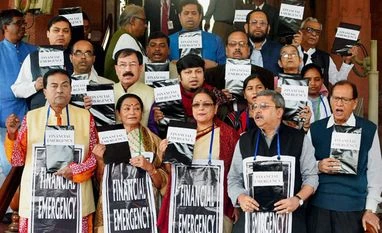
A united Opposition is trying to corner the Narendra Modi-led government over the issue of demonetisation of Rs 500 and Rs 1,000 currency notes -- both outside and inside Parliament. It has termed the government move 'economic anarchy'.
While ten opposition paties have joined hands demanding a reply from Prime Minister Narendra Modi on the floor of the House, no major business has been transcated in Parliament since the Winter Session began on November 16. Both the Houses are witnessing repeated adjournments, with Opposition leaders shouting slogans and storming the well of the House repeatedly.
The Opposition also hit out at Modi saying he could address public meeting, but not be present in Parliament. "The Prime Minister comes to Parliament, sits in his chamber, but doesn't attend either the Lok Sabha or the Rajya Sabha, which is a matter of concern, not just for the Opposition, but also for the 1.3 billion people of this country. After all, we want to know the reason why the Prime Minister does not want to come to both Houses, but feels free to give speeches outside Parliament," Leader of the Opposition in the Rajya Sabha Ghulam Nabi Azad said.
Leaders of the Congress, Trinamool Congress, Janata Dal (United), Bahujan Samaj Party, Communist Party of India (Marxist), Communist Party of India, Nationalist Congress Party, Rashtriya Janata Dal, Jharkhand Mukti Morcha and Dravida Munnettra Kazhagam held a meeting to forge a common action plan to mount an attack on the government.
At the meeting, attended by Congress Vice-President Rahul Gandhi, it was decided that these parties will continue to press for an adjournment motion in the Lok Sabha, and a debate under a rule that entails voting.
The Rajya Sabha, which saw a day-long inconclusive debate on demonetisation on the opening day of the session on November 16, has failed to function since, with the Opposition pressing for the presence of the Prime Minister in the House before the discussion could be resumed.
The government, on its part, is equally adamant; it has refused to accept this demand, saying Finance Minister Arun Jaitley has been present in the House all through the debate and he will reply to every query.
It was decided that MPs of these 10 parties would stage a sit-in near Mahatma Gandhi's statue in the Parliament complex on Wednesday. This will be followed by a march to Rashtrapati Bhawan, date for which is being worked out, according to sources.
With major Bills like Goods and Service Tax (GST) listed for discussion, the winter session looks heading for a whitewash.
In a move that had taken everyone by surprise, Modi had on the evening of November 8 said that Rs 500 and Rs 1,000 would cease to be legal tender within a few hours of the announcement.
Upping the ante outside Parliament against demonetisation are Delhi Chief Minister Arvind Kejriwal and his West Bengal counterpart Mamata Banerjee, who have jointly led a march to Rashtrapti Bhawan and also met President Pranab Mukherjee.
They have addressed vegetable and fruit sellers of Azadpur mandi and gave an ultimatum to the government to rollback the order.
Mamata Banerjee is likely to visit the national capital on Tuesday for the agitational programme.
In order to garner support of the masses, the opposition leaders from Gandhi, Kejriwal, Banerjee to BSP supremo Mayawati and others are reaching out to people who are standing in long queues outside banks and ATMs.
Gandhi was the first one to visit a bank to get the exchange of Rs 4,000 and has went to various banks and ATMs thrice to meet the people. On Monday, Banerjee met the RBI officials in Bengal and raised people's concerns.

 "Demonetisation: United Opposition demands reply from PM, sticking to guns")

