
5G tech a tool for freedom, not for suppression and censorship, says Trump
The US has already banned Huawei, the world leader in telecom equipment and the number two smartphone producer, over concerns of security
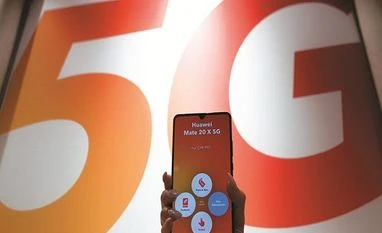 "5G tech a tool for freedom, not for suppression and censorship, says Trump")
WebinarsNew
Deep DiveNew
Explore Business Standard
The US has already banned Huawei, the world leader in telecom equipment and the number two smartphone producer, over concerns of security
The 5G telecom technology should be a tool for freedom and prosperity and must not be used as a conduit for suppression and censorship, US President Donald Trump said on Tuesday, remarks seen as a clear reference to Chinese firm Huawei against which the US slapped sanctions.
The US has already banned Huawei, the world leader in telecom equipment and the number two smartphone producer, over concerns of security.
In his media statement after talks with Prime Minister Narendra Modi, Trump also referred to "Quad", a coalition of India, the US, Australia and Japan formed to ensure peace and stability in the Indo-Pacific in the backdrop of China's aggressive military posturing in the region.
The US president also talked about the Blue Dot Network, an initiative to develop sustainable infrastructure among like-minded countries and increasingly seen as a counter to China's Belt and Road Initiative.
On 'Quad', Trump said he and Modi discussed ways to revitalise the coalition.
"Together, the Prime Minister and I are revitalising the Quad Initiative with the United States, India, Australia and Japan," Trump said, with Modi by his side.
The US president said the 5G issue also figured in his talks with Modi.
"We discussed the importance of a secure 5G wireless network and the need for this emerging technology to be a tool for freedom, progress, prosperity -- not to do anything where it could be even conceived as a conduit for suppression and censorship," Trump said.
India has decided to allow Huawei to participate in 5G trials. China welcomed India's decision.
The Trump administration placed Huawei and its affiliates on a blacklist. The US fears that telecom systems built by Huawei could be used by the Chinese government for espionage.
On Blue Dot Network, the US President said there was a need for having trustworthy options for high-quality infrastructure development.
"To guarantee that the infrastructure of the future is built in a safe, transparent, and accountable manner, the United States is working with a range of partners, including Australia and Japan, to create the Blue Dot Network," he said.
He described the network as a major initiative to ensure countries around the world to have access to private sector-led, sustainable, and trustworthy options for high-quality infrastructure development.
First Published: Feb 25 2020 | 11:06 PM IST


 Connect with us on WhatsApp