This was announced by Premier Li Keqiang in his report submitted to the National People's Congress, which began its 10-day annual session today
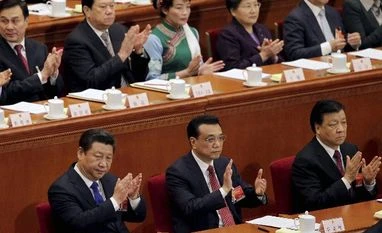
Chinese President Xi Jinping, second left at bottom, and Premier Li Keqiang, second right at bottom, applaud with delegates during the opening session of the National People's Congress at the Great Hall of the People in Beijing
Unfazed by its slowing economy, China today hiked the defence budget by 10.1 per cent this year to $144.2 billion aimed at modernising the world's largest military, almost $104 billion more than India's defence expenditure of $40 billion.
The increase of the defence spending was announced by Premier Li Keqiang in his work report submitted to the China's legislature the National People's Congress (NPC), which began its 10-day annual session here today.
The hike - a double-digit annual increase for the fifth year in a row - marks an increase of about $12 billion over last year's budget of $132 billion, making China the second largest military spender after the US whose national defence budget accounted to about $600.4 billion in 2013.
Chinese official media, however, said the hike is the lowest in five years as the second largest economy confronts mounting pressure in the face of an economic slowdown.
Chinese economy grew last year at 7.4 per cent missing the lowest in 24 years missing the official target of 7.5 per cent.
Li in his work report fixed the GDP target for this year at seven per cent.
According to a budget report released shortly before the NPC, the government plans to raise defence budget to 886.9 billion yuan (about USD 144.2 billion).
Nonetheless, the 10.1-per cent rise represented the lowest expansion in China since 2010.
The figure has thereon been riding on a multi-year run of double-digit increases, expanding 12.2 per cent last year.
Today's budget report did not explain the rationale behind this year's abated growth, but said national defence development would be coordinated with the economic growth.
The report played down brewing new concerns that the world's economic powerhouse is losing steam stressing that China is now in a "new normal" state, where a balance ought to be stricken between growth and structural optimisation.
It said China will comprehensively strengthen modern logistics, step up national defence research and development of new- and high-technology weapons and equipment, and develop defense-related science and technology industries.
"Building a solid national defence and strong armed forces is fundamental to safeguarding China's sovereignty, security, and developmental interests," the report said.
China's military spending has long been a source of concern to India and other countries in the region.

 "China hikes defence budget by 10.1%")


 Connect with us on WhatsApp