Grappling with the international tribunal's verdict quashing its claims over the South China Sea, China on Wednesday turned down US advise to follow India's example of settling its maritime row with Bangladesh by implementing the judgement saying that there is "no comparison" between the two cases.
"There is a premise for the settlement of the relevant territorial dispute between India and Bangladesh through arbitration, that is, the two respected each other's sovereign wills and reached an agreement on the arbitration request through consultation," Chinese Foreign Ministry spokesman Lu Kang told PTI here.
"It is not like imposing one party's will on the other" unlike the Philippines which "unilaterally" filed the petition in Permanent Court of Arbitration (PCA), he said in response to question over US Assistant Secretary of Defence for East Asia. Denmark's recent comments that China should follow India's example of resolving its maritime boundary dispute with Bangladesh by implementing the award by a similar tribunal appointed by the PCA.
India accepted the award which was given in favour of Bangladesh to resolve the over 40-year maritime row.
The tribunal awarded Bangladesh 19,467 sq km of area in Bay of Bengal in 2014.
"To India's great credit, it accepted the decision and has abided by it, noting at the time that settlement of the issue would enhance mutual understanding and good will between the two countries. This is an example we would encourage China to follow," Denmark told lawmakers at a Congressional hearing in Washington last week.
"The arbitral tribunal's upcoming ruling will present an opportunity for those in the region to determine whether the Asia-Pacific's future will be defined by adherence to international laws and norms that have helped keep the peace and enabled it to prosper, or whether the region's future will be determined by raw calculations of power," Denmark said.
China however emphatically rejected the verdict questioning the legality of the tribunal.
Lu said previous Philippines President Benigno S Aquino unilaterally opted for arbitration and "imposed" it on China.
"By doing that the Aquino administration severely violated the agreement between China and Philippines and the consensus in the region, breached relevant provisions under UN Convention on Law of Seas (UNCLOS), infringed upon China's right as a sovereign state and state party to UNCLOS to resolve disputes by means of its own choice and went against international law," he said.
"Therefore there is no comparison between the two things," he said.
China claims almost all of the South China Sea but its claims are fiercely contested by the Philippines, Vietnam, Malaysia, Brunei and Taiwan.
China faced a piquant situation as the PCA tribunal completely struck down its claims over 90% of the South China Sea based on historic rights and upheld the Philippines' maritime right to have Exclusive Economic Zone.
For decades China, which boycotted the tribunal questioning its legality, has been asserting that the islands and reefs in the South China Sea were discovered 2,000 years ago and administered by its emperors.
But its claims came into conflict with the Philippines, Vietnam, Malaysia, Brunei and Taiwan as they have exclusive economic zones provided by UNCLOS which Beijing declined to recognise.
Testifying before the same committee, Colin Willett, Deputy Assistant Secretary of State for Multilateral Affairs Bureau of East Asian and Pacific Affairs, also praised India for peacefully resolving its maritime dispute with Bangladesh.
"The region abounds with examples of neighbours finding peaceful ways to resolve difference over overlapping maritime zones.
"Indonesia's and the Philippines' successful conclusion of negotiations to delimit the boundary between their respective exclusive economic zones (EEZs) and India's and Bangladesh's acceptance of the decision from an arbitral tribunal with regard to their overlapping EEZ in the Bay of Bengal are just a couple that come to mind," he said.

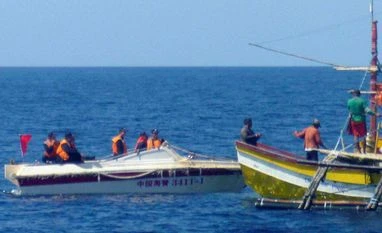 "China rejects US advise to follow India's example over South China Sea row")


 Connect with us on WhatsApp