As delegates got a three-hour recess to go through the document, French President Hollande called Modi in an apparent bid to persuade India to go with the deal
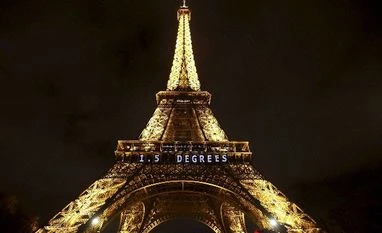
The slogan "1.5 DEGREES" is projected on the Eiffel Tower as part of the COP21, United Nations Climate Change Conference in Paris, France
The climate change conference today came out with an ambitious final draft of a deal that proposes limiting global warming to "well below" 2 degrees Celsius and committing $100 billion a year from 2020 to help developing countries in coping with the problem.
The target of well below 2 degrees Celsius and even more ambitious 1.5 degrees Celsius may not be acceptable to developing countries like India and China which prefer a ceiling of 2 degrees Celsius that would allow them to burn fuels like coal for a longer period.
Amidst cheers and applause from delegates from 195 countries, the draft of the "historic" deal was presented by French Foreign Minister Laurent Fabius and President Francois Hollande appealed to the gathering to approve the accord.
As delegates got a three-hour recess to go through the document, Hollande called Prime Minister Narendra Modi in an apparent bid to persuade India to go with the deal.
External Affairs Ministry Spokesperson said Hollande discussed the latest status on the deal. "PM appreciated the gesture."
After 13 days of hard negotiations, Fabius described the final draft negotiating text as being "fair, durable and legally binding".
Fabius said the agreement would aim at limiting warming to "well below" 2 degrees Celsius and try for an even more ambitious goal of 1.5 degrees Celsius.
The deal also seeks to mobilise a minimum of USD 100 billion (about Rs 6,70,000 crores) a year from 2020 to help the developing world cope with global warming, he said.
Importantly, a new figure for the financing would be set by 2025, Fabius said, adding that it would enshrine the annual $100 billion as a "floor" -- a minimum for the future.
If adopted by the nations, this will be the final agreement to reduce green house gas emissions. But if nations do not adopt it, it will mean failure.
Hollande and UN Secretary General Ban Ki-moon were present at the unveiling of the draft.
"The text is ambitious and realistic. France calls upon nations to adopt first universal agreement on climate change," Hollande said.
"You have to take the final step, the decisive step which allows us to reach the goal," he said, adding that all countries cannot be satisfied with the agreement.
Fabius said if the text is adopted by the nations, it will mark a "historic turning point".
"The focus is not on red lines but on green lines," he said.

 "Draft climate pact aims at 'well below' 2 degree Celsius limit")


 Connect with us on WhatsApp