
5 labour surveys including on migrants, domestic workers to begin by Apr 1
The third pre-testing of the five surveys would be conducted in next ten days and then the studies would begin across the country by the Labour Bureau
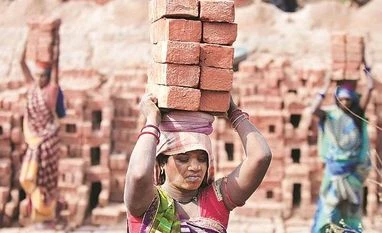 "5 labour surveys including on migrants, domestic workers to begin by Apr 1")
WebinarsNew
Deep DiveNew
Explore Business Standard
The third pre-testing of the five surveys would be conducted in next ten days and then the studies would begin across the country by the Labour Bureau
The Labour Bureau is all set to launch its five major surveys, including on migrant and domestic workers, across the country by April 1 as two out of three mandated pre-testings of the studies yielded "encouraging and positive results".
The third pre-testing of the five surveys would be conducted in next ten days and then the studies would begin across the country by the Labour Bureau, which is a wing of the Ministry of Labour & Employment.
Talking to PTI, Director General Labour Bureau D P S Negi said, "There are very encouraging and positive results of two pre-testings of these five surveys. The third testing in certain pocket would be done in next ten days. We are hopeful to launch all five surveys across the country by April 1 and work on ground to release results in seven to eight month."
Last week on February 20, Labour Bureau Chandigarh, an attached office of the Ministry of Labour & Employment, organised a training of trainers for the five all-India surveys relating to domestic workers, migrant workers, employment generated by the professionals, the employment generated in transport sector and the all India quarterly establishment-based employment survey.
The all-India training of trainers was presided over by Prof. S P Mukherjee, the chairman of the expert group; Dr. Amitabh Kundu, the co-chairman of the expert group and D P S Negi, the Director General of Labour Bureau.
The back-to-back training sessions were a part of the three-day comprehensive training sessions to be imparted to the officers/officials of the Labour Bureau, the officers from the seven regional offices of the Labour Bureau and the officials from various state governments.
Detailed power point presentations explaining the objectives, sampling design and schedules for each of the five surveys viz. All India Surveys relating to domestic workers, migrant workers, employment generated by the professionals, the employment generated in transport sector, and the all-India quarterly establishment-based employment survey were made by the officers of the Labour Bureau.
The schedules to be canvassed were deconstructed block-wise for each of the five all-India surveys in detail.
There was also a detailed question and answer session in which field investigators raised questions and sought clarifications regarding various questions in the schedules to be canvassed.
These trainings are a precursor to the trainings that will eventually be imparted to the field officers who will ultimately undertake the surveys across the country.
The field investigators were sent out to the field for a pre-testing survey to canvass the schedules for each of the five all-India surveys. The sample included both rural and urban pockets.
Each team comprised of 7 to 8 Investigators and they were accompanied by officers of the IES (Indian Economic Services) and ISS (Indian Statistical Services) to supervise the pre-testing exercise.
Thereafter, detailed presentations were made by each team in order to apprise Prof. S P Mukherjee, Dr. Amitabh Kundu, D P S Negi and other senior officers about the learnings from the field visit.
The learnings included observations, problems faced while canvassing the schedules, etc.
The field investigators flagged a few teething issues that they encountered while canvassing the schedules.
The chairman and other members of the expert group took note of all these issues. For example, in case of the pre-testing exercise of the all-India survey on employment generated by professionals, the investigators suggested that prior appointments with professionals may be sought for smooth canvassing of the schedules.
The training session concluded with the inspiring remarks of D P S Negi, who deeply appreciated the efforts put in by the field investigators as well as the officers for making the pre-testing exercise a huge success.
He further stated that the data collected through these five all-India surveys will provide important inputs for evidence-based policy making.
Besides, data thus collected would help to fill the data gaps that existed until now as far as migrant and domestic workers are concerned.
(Only the headline and picture of this report may have been reworked by the Business Standard staff; the rest of the content is auto-generated from a syndicated feed.)
First Published: Feb 22 2021 | 5:10 PM IST

