
India needs green energy policy to get 175-Gw solar capacity by 2022: CSE
CSE Director General Sunita Narain said this at a national conference where she released a report titled the 'State of Renewable Energy in India 2019'.
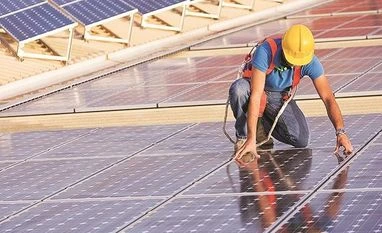 "India needs green energy policy to get 175-Gw solar capacity by 2022: CSE")
WebinarsNew
Deep DiveNew
Explore Business Standard
CSE Director General Sunita Narain said this at a national conference where she released a report titled the 'State of Renewable Energy in India 2019'.
India would fall short of the government's target of achieving 175 GW of solar capacity by 2022, city-based think tank Centre for Science and Environment (CSE) said on Monday.
CSE Director General Sunita Narain said this at a national conference where she released a report titled the "State of Renewable Energy in India 2019".
Emphasising the need for a renewable energy policy to meet the needs of the poorest people in the country, she said there were several challenges like air pollution, climate change and lack of clean fuel for cooking for which renewable energy was essential.
"We believe that India needs a renewable energy policy that is less about industry and more about ensuring supply to meet the needs of the poorest in the country. It should be a means to both de-carbonise the economy and provide access to large numbers of people who are energy-deprived.
"Renewable energy is not just another infrastructural challenge, rather this sector is important to achieve the challenges of modern era," Narain said.
During the two-day conference on renewable energy, International Solar Alliance Director Upendra Tripathy said the ISA is going to propose a new bank exclusively for financing energy access to billions.
Citing a recent World Bank report, Tripathy said 600 million people would not have access to energy even in 2040.
The existing banks do not focus on universal energy access and those still deprived are the poorest of the poor. Thus, out of the ambit of these banks, special finance mechanism is needed to target these people, he said.
Priyavrat Bhati, advisor, Energy group, CSE, said that renewable energy got a boost in 2015 when India decided to install 175 GW capacity of such energy by 2022, but the momentum seems to have slowed down in the last year.
Bhati, while referring to the key concerns identified by the report, said inconsistent policy has been the bane of the renewable energy sector
"Nothing can be more disruptive for an emerging sector that seeks to attract global investors, than ad hoc and abrupt policy changes," he said.
The CSE report recommended increase in the share of distributed renewable generation solar rooftops and mini-grids -- besides encouraging 'smart grids' that use communications infrastructure, control systems and information technology for efficient delivery.
It also suggested investing in developing inexpensive energy-storage capacity, adding that an indigenous research can improve existing technology in terms of cost and performance.
(Only the headline and picture of this report may have been reworked by the Business Standard staff; the rest of the content is auto-generated from a syndicated feed.)
First Published: Jan 21 2019 | 7:20 PM IST

