
IMF chief Gopinath roots for labour reforms, bank cleanups to revive growth
Responding to a question, Gopinath said India's medium-term vision to reach a USD 5-trillion economy which focuses on boosting investment is appropriate.
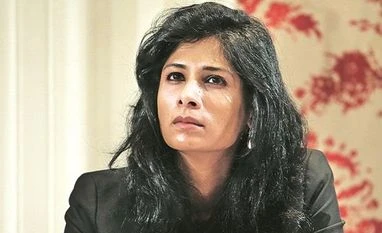 "IMF chief Gopinath roots for labour reforms, bank cleanups to revive growth")
WebinarsNew
Deep DiveNew
Explore Business Standard
Responding to a question, Gopinath said India's medium-term vision to reach a USD 5-trillion economy which focuses on boosting investment is appropriate.
With economic growth slowing to a six-year low, IMF Chief Economist Gita Gopinath says the government should undertake structural reforms such as bank clean-up and labour reforms to address the slowdown in domestic demand.
Gopinath, 48, who is travelling to India this week, rooted for government policies focusing on managing a slowdown in domestic demand, and on boosting productivity growth and supporting employment creation in the medium term.
"Given the cyclical position and the structural challenges of the Indian economy at this point, we recommend that policies focus on managing the slowdown in domestic demand, and on boosting productivity growth and supporting employment creation in the medium term," she told PTI in an interview.
Recommending a series of key policy priorities for the Prime Minister Narendra Modi government, she said, "Politically, the time -- early in the government's second term -- is right for a structural reform push."
GDP growth slowed for the sixth consecutive quarter in the July-September quarter to 4.5 per cent as manufacturing slumped on low domestic consumption.
Kolkata-born Gopinath said the policy priorities of the government should also include a credible fiscal consolidation path that is more ambitious than currently envisaged by the government.
"This is needed to reduce the high level of debt and reduce crowding out which would free up financial resources for private investment. This should be driven by subsidy-spending rationalisation and tax-base enhancing measures," Gopinath said.
Responding to a question, Gopinath said India's medium-term vision to reach a USD 5-trillion economy which focuses on boosting investment is appropriate. And so is the commitment to support the rural economy, boost infrastructure spending, streamline the goods and services tax (GST), direct tax reforms, and pursue a business-friendly policy agenda, she noted.
In this regard, Gopinath advocated, among others, three policy priorities for the Government of India.
First is to accelerate the clean-up of the banks, other financial institution, and corporate balance sheets and enhance governance of public sector banks to revive bank credit and enhance the efficiency of credit provision, while monitoring closely emerging risks from the liquidity stress in non-banking financial companies (NBFCs) and enhancing supervision and regulation of the NBFCs.
The Indian-American called for continued fiscal consolidation over the medium term -- both at the Center and state levels -- to lower elevated public debt levels, supported by further steps to increase tax compliance and administration, as well as improve fiscal transparency.
And finally, labour, land, and product market reforms aimed at enhancing competition and governance, along with infrastructure investment, should be a priority to create more and better jobs for India's young and rapidly growing labour force.
"Improvements in health and education are essential for broad-based inclusive growth," Gopinath said.
Responding to a question, Gopinath said, "The extent of the slowdown of the Indian economy has surprised many, including us here at the IMF (International Monetary Fund)."
"Growth slowed further to a six-year low of 4.5 per cent (year-on-year) in the second quarter of FY2019-20 (July-September 2019), from 5 percent (year-on-year) in the previous quarter. A sharp moderation of investment, slowing consumption growth, and an inventory rundown contributed to the slowdown," she said.
"We see several factors underlying the weakness of consumption and investment," said the top IMF economist. "Rural income growth has been weak. Good monsoon rainfall, agriculture sector reform, and food management improvements have pushed down food prices. The low food prices represent a positive development in that they have supported the efforts of the Reserve Bank of India to keep inflation under control."
She said low food prices hold back farmers' income and thereby dampen demand. "Stresses in the bank and non-bank financial sector have adversely affected the availability of credit in the economy."
"Consumption and investment have also been weighed down by weaknesses in specific sectors such as automobiles and real estate. Business sentiment has declined sharply," said the IMF's chief economist.
First Published: Dec 16 2019 | 4:30 PM IST


 Connect with us on WhatsApp