Home / India News / Citizenship Act: Indian-Americans, students protest in Chicago, Boston
Citizenship Act: Indian-Americans, students protest in Chicago, Boston
"We are outraged by the violence and actively condemn the brutality inflicted upon students at Jamia Milia Islamia and Aligarh Muslim University (AMU)," said the Indian students in Chicago.
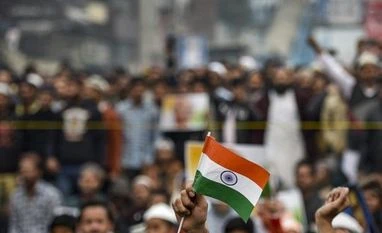
New Delhi: A protestor holds the national flag during a demonstration against the Citizenship Amendment Act (CAA) at Jamia Nagar in New Delhi | Photo: PTI
Indian-Americans and Indian students held peaceful protests against the Citizenship Amendment Act in the US cities of Chicago and Boston, saying this is a step towards rupturing India's social fabric.
About 150 people marched to the Indian consulate from the Tribune Tower in Chicago.
"Chicago condemns the egregious behaviour of the Indian government," the protesting students said in a statement.
"We are outraged by the violence and actively condemn the brutality inflicted upon students at Jamia Milia Islamia and Aligarh Muslim University (AMU)," said the Indian students in Chicago.
Indian-American Muslim Council (IAMC), in a statement, strongly condemned the alleged "brutal crackdown" on students of Jamia and AMU.
"We have watched this tragic unfolding of events with great concern and anguish. The all India National Register of Citizens (NRC) and Citizenship Amendment Law will have a primal impact on the Indian polity. This is a step towards rupturing India's social fabric and students should at the very least have the democratic right to protest," said IAMC president Ahsan Khan.
A diverse section of the Indian diaspora gathered on the steps of the Massachusetts Institute of Technology (MIT) early this week with a call to boycott the NRC and repeal the CAA, 2019.
Among those gathered consisted of scientists, engineers, students, service workers and computer professionals, artists and doctors, social justice activists, left and liberal intellectuals and community leaders.
"Just like the immigrants are being discriminated and criminalised in the US, similarly the Muslims and other minorities in India are being criminalised because of the NRC. Our struggles are very similar and we have to fight these oppressive powers together," said Alonso Espinosa from MIT Students Against War (MITSAW).
Rozina Amin Zama from Indian American Muslims Council Boston Chapter, which is a part of the The Boston Coalition, said "The religious test of CAB is without a doubt unconstitutional and goes against universally accepted human rights framework. For example the Hindus and Buddhists from Sri Lanka, Atheists from Bangladesh, and Ahmadi Muslims from Pakistan are excluded while the Indian government claims to protect its minorities".
According to the CAA, members of Hindu, Sikh, Buddhist, Jain, Parsi and Christian communities -- who came from Pakistan, Bangladesh and Afghanistan till December 31, 2014 following religious persecution -- will get Indian citizenship.
The protesters claim that the legislation is "unconstitutional and divisive" as it excludes Muslims.

 "Citizenship Act: Indian-Americans, students protest in Chicago, Boston")


 Connect with us on WhatsApp