With barely a fortnight to go for a meeting between Prime Minister Narendra Modi and Russian President Vladimir Putin, a key pact on units five and six of Kudankulam nuclear plant awaits clearance from the Prime Minister's Office (PMO).
The General Framework Agreement (GFA) for units 5 and 6 of the plant in Tamil Nadu has already been cleared by an inter-ministerial group and is with the PMO for its nod, government sources said, suggesting that no final assurance has been given to the Russian side so far on whether the pact will be inked during Modi-Putin meeting in St Petersburg on June 1.
A GFA is the final agreement before a project can commence.
"After its evaluation by the inter-ministerial group, the proposal has now been sent to the PMO and is awaiting its green signal," a top government source said.
Significantly, Russian Deputy Prime Minister Dmitry Rogozin was here last week to prepare the ground for the bilateral meet between the two leaders.
He co-chaired an inter-governmental commission meeting with External Affairs Minister Sushma Swaraj where the two sides agreed to take forward collaborative projects in a range of sectors, including nuclear energy, and joint projects in third countries.
According to an October 2015 joint statement after a meeting between Modi and Putin, the two sides "reaffirmed" their intention to conclude the GFA and the Credit Protocol for Kudankulam Nuclear Power Plant (KKNPP) units 5 and 6 by the end of 2016.
Government sources said the GFA between India and Russia was to be signed by December 2016. They also added that it was pending because the two sides had disagreement over credit protocol.
The delay also comes in the backdrop of concerns in India over growing proximity between Moscow and Islamabad. India also wants Russia to make more efforts to get New Delhi into the elite Nuclear Suppliers Group (NSG).
A part of the KKNPP project, units 5 and 6, with a capacity of 1000 MW each, are being built with Russian collaboration.
Unit 1 and 2 of the KKNPP are already operational.
In August 2016, Modi and Putin jointly dedicated Unit 2 of the plant to "India-Russia Friendship and Cooperation" and witnessed the laying of foundation concrete for Kudankulam units 3 and 4 through video-link.

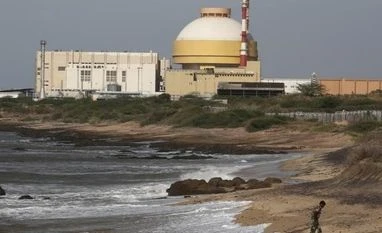 "Kudankulam nuclear plant: GFA for units 5, 6 awaits PMO clearance")


 Connect with us on WhatsApp