Home / Economy / News / Lok Sabha passes Appropriation Bill authorising govt to draw Rs 110 trn
Lok Sabha passes Appropriation Bill authorising govt to draw Rs 110 trn
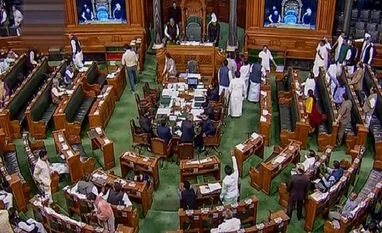
The house passed the Bill, envisaging spending of Rs 110.4 trillion during the financial year 2020-21 after Speaker Om Birla applied 'guillotine' on demands of grants for various ministries.
The Lok Sabha will now discuss the Finance Bill, which essentially contains the government's tax proposals.
The Lok Sabha on Monday passed the Appropriation Bill 2020-21, authorising the government to draw over Rs 110 trillion from the Consolidated Fund of India for its working as well as implementation of its programs and schemes. This completes two-thirds of the exercise for approval of the Budget for 2020-21.
Lok Sabha and Rajya Sabha had debated on Finance Minister Nirmala Sitharaman's second Budget in the first half of the current session and in the second part, the lower house of Parliament passed the Appropriation Bill. In the third stage, the Finance Bill, which details the tax proposals, will be discussed and approved.
The house passed the Appropriation Bill, envisaging spending of Rs 110.4 trillion during the financial year 2020-21 after Speaker Om Birla applied 'guillotine' on demands of grants for various ministries.
With Parliament having very limited time for scrutinising the expenditure demands of all the ministries, it takes up discussion on spending or demands for grants for a few ministries during a pre-decided period of time. Once this is over, a guillotine is applied.
Once the speaker applies the guillotine, all the outstanding demands for grants, whether discussed or not, are put to vote at once and passed. After this, Appropriation Bill was taken into consideration and passed.
This year, the Lok Sabha discussed demands for grants of ministries of tourism, railways and social justice and empowerment. Finance Minister Nirmala Sitharaman moved the Appropriation Bill, which was passed by voice vote.
The Lok Sabha will now discuss the Finance Bill, which essentially contains the government's tax proposals.
Once the Finance Bill is passed, the budget exercise is complete. Both appropriation and finance bills are classified as money bills which do not require the explicit consent of the Rajya Sabha. Rajya Sabha only discusses them and returns the bills.
After passing of the Finance Bill, it enters the statute as the Finance Act. Thus, the final Budget gets approved. While guillotine literally is a large, weighted blade used for executing a condemned person, in legislative parlance, to 'guillotine' means to bunch together and fast-track the passage of financial business. It is a fairly common procedural exercise in Lok Sabha during the Budget Session.
After the Budget is presented, Parliament goes into recess for about three weeks, during which the House Standing Committees examine demands for grants for various ministries, and prepare reports. After Parliament reassembles, time is allotted for discussions on the demands for grants of some ministries.

 "Lok Sabha passes Appropriation Bill authorising govt to draw Rs 110 trn")


 Connect with us on WhatsApp