
Slowdown has bottomed out, govt's measures will boost growth: SBI MD Khara
Khara told PTI that for India to achieve its ambition of becoming a five trillion dollar economy, it required a 10-11% growth rate
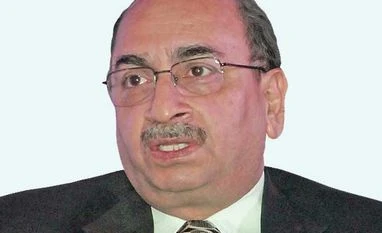 "Slowdown has bottomed out, govt's measures will boost growth: SBI MD Khara")
WebinarsNew
Deep DiveNew
Explore Business Standard
Khara told PTI that for India to achieve its ambition of becoming a five trillion dollar economy, it required a 10-11% growth rate
Slowdown in the Indian economy has bottomed out and measures taken by the government in the recent budget to improve capacity to spend in rural sector, infrastructure creation and inviting foreign investments will boost growth, State Bank of India Managing Director Dinesh Khara has said.
Khara told PTI here that for India to achieve its ambition of becoming a five trillion dollar economy, it required a 10-11 per cent growth rate.
India's economic growth slipped to hit an over six-year low of 4.5 per cent in July-September 2019.
He underlined that several initiatives and measures have been taken by the government to attract investment into the economy, including reduction in tax rates, terming it a "landmark decision" that will go a long way in attracting investment from overseas.
Khara was in the city and had addressed students at Columbia Business School on 'SME Lending in India', an event organised by SBI in association with the Business School, its student-run organisation South Asia Business Association (SABA) and School of International and Public Affairs (SIPA).
Highlighting that to achieve high growth, there was a need for much higher savings and investments, he said that currently the investment rate was about 32 per cent to the GDP and savings rate was about 27 per cent.
"There is a gap," he said, adding that if the economy has to grow at 10-11 per cent, the investment rate has to be about 40 per cent.
"For that there is a felt need for attracting investment from overseas. The infrastructure sector is another area where there is a whole lot of opportunity and there is a felt need in the economy to encourage this sector," Khara said.
He noted that in the recent budget the government announced various measures to support the infrastructure sector and a major one among them was to invite investments from the sovereign wealth funds and interest income of these funds will be tax exempt.
"This is a very major step which has been taken to attract investment," he said.
"These kinds of measures which have been taken will go a long way in terms of supporting the government's effort for building up infrastructure and revving up growth of the economy," Khara said.
Such measures have a very significant multiplier effect, he said.
"In the recent budget, there has been very clear focus on improving the capacity to spend for the rural sector, on infrastructure creation and inviting foreign investment. I think it's a very well directed budget for achieving the outcomes which are intended," he said.
When asked during an interactive session on the economic slowdown and if it has bottomed out, Khara referred to the Purchasing Managers' Index (PMI) for India which shot up to 55.3 in January from 52.7 in December.
"So that itself is a reflection that it has already bottomed out and we are on the upside. And apart from that the kind of initiatives which have been taken by the government in the recent budget will go a long way in terms of supporting the economy," he said.
Outlining reasons for the slowdown in the Indian economy, Khara said it was the consumption engine that had slowed down.
"My assessment is that demand from the rural sector is quite muted. That is one of the major reasons for the kind of slowdown which we are witnessing," he said.
The rural economy in India is supported by the money order economy - remittances which flow from the urban sector to the rural sector, he said , adding that the real estate and auto were two major sectors that used to offer opportunities for people from rural areas.
"I would say that the money order economy almost collapsed. That is another reason for this kind of muted demand seen from the rural sector," he said.
The government's focus on recreating and repairing the real estate sector by introducing the Special Window for Affordable and Mid-Income Housing (SWAMIH) Investment Fund is a major step, he said, adding that focus on infrastructure creation will also go a long way in creating employment.
The PM Kisan Yojna, under which an income support of Rs 6000 per year will be provided to all farmer families across the country, will also bring in enough liquidity in the rural sector, Khara said.
"Liquidity in the rural sector is more important than anywhere else because the marginal propensity to consume is significantly higher in the rural sector than elsewhere. These are some other measures which have been taken which will go a long way in terms of supporting the build up of the economy once again," he said.
He said that once demand-related issues were addressed, it will help in boosting growth.
Khara also pointed out that looking into data for last for 30 years, it had been observed that in every cycle of 10 years, there has been a slowdown or single digit growth for at least two to three years.
"So, from that point of view this 4.5 per cent growth which we have seen in this current cycle of 10 years is one in line with the trend seen in the past two," he said.
Asked if India can become an economic success without manufacturing, Khara said that auto and auto-ancillary and pharma were the two manufacturing sectors which could integrate with the global supply chains and will continue to be the future sectors of growth.
First Published: Feb 28 2020 | 11:48 AM IST


 Connect with us on WhatsApp