
Moderation in India's growth coincides with global situation: Anurag Thakur
Thakur said India's growth trajectory over the period 2014-15 to 2018-19 is characterised by macroeconomic stability with real GDP growth averaging 7.4%
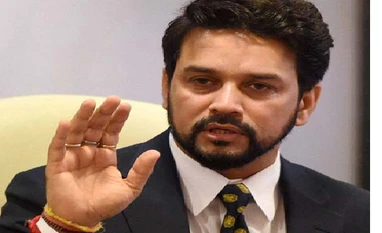 "Moderation in India's growth coincides with global situation: Anurag Thakur")
WebinarsNew
Deep DiveNew
Explore Business Standard
Thakur said India's growth trajectory over the period 2014-15 to 2018-19 is characterised by macroeconomic stability with real GDP growth averaging 7.4%
The moderation in India's growth coincides with a deceleration in growth of global output and the IMF has projected the country's GDP growth to pick up to 5.8 per cent in 2020, Union Minister Anurag Thakur said in Lok Sabha.
Thakur said India's growth trajectory over the period 2014-15 to 2018-19 is characterised by macroeconomic stability with real GDP growth averaging 7.4 per cent.
"The moderation in India's growth coincides with a deceleration in growth of global output, as estimated by the IMF, in recent years," he said replying a question of Congress MP Abdul Khaleque and TMC's Saugata Roy during Question Hour.
Thakur, union minister of state for finance, said the IMF has projected India's GDP growth to pick up to 5.8 per cent in 2020.
The economic survey 2019-20 has also projected a pick-up in India's growth in the range of 6.0 per cent to 6.5 per cent in 2020-21.
The RBI's sixth bi-monthly monetary policy statement, 2019-20 has also projected GDP growth of 6.0 per cent for 2020-21.
Thakur said as per the National Statistical Office's first advance estimates of national income, 2019-20, India's real GDP is estimated to grow at 5.0 per cent in 2019-20.
He said the World Economic Outlook Update (January 2020) published by the International Monetary Fund (IMF) has revised India's GDP growth rate to 4.8 per cent in 2019.
This revision in growth may not cause any stress in the Non-Banking Financial Companies (NBFCs) sector as NBFCs are well capitalised, he said.
The minister said the government has implemented several major structural reforms in recent years to bolster investment and growth.
These include Insolvency and Bankruptcy Code (IBC) to strengthen the financial system, Goods and Services Tax (GST) to simplify the indirect taxation regime, Make-in-India programme to boost domestic manufacturing capacity, liberalisation of Foreign Direct Investment (FDI) and Jan Dhan-Aadhaar-Mobile (JAM) Trinity towards greater transparency, efficiency and financial inclusion, he said.
Thakur also said recently, the corporate tax rate has been cut to 15 per cent for new domestic manufacturing companies, which is amongst the lowest in the world.
In December 2019, he said, the government has announced the Rs 103 lakh crore National Infrastructure Pipeline which would significantly boost infrastructure and spur growth impulses in the economy.
First Published: Feb 10 2020 | 1:38 PM IST


 Connect with us on WhatsApp