New mind-controlled robotic wheelchairs developed
The interface uses signals from neurons recorded in two regions of the brain involved in movement and sensation
Press Trust of India Washington Scientists, including one of Indian origin, have developed a brain-machine interface that allows monkeys navigate a robotic wheelchair using just their thoughts, an advance that may help people who have lost muscle control and mobility in future.
The interface uses signals from hundreds of neurons recorded simultaneously in two regions of the monkeys' brains that are involved in movement and sensation.
As the animals think about moving towards their goal - in this case, a bowl containing fresh grapes - computers translate their brain activity into real-time operation of the wheelchair.
The interface demonstrates the future potential for people with disabilities who have lost most muscle control and mobility due to quadriplegia or amyotrophic lateral sclerosis (ALS), said senior author Miguel Nicolelis, co-director for the Duke University's Centre for Neuroengineering in US.
"In some severely disabled people, even blinking is not possible," Nicolelis said.
"For them, using a wheelchair or device controlled by noninvasive measures like an EEG (a device that monitors brain waves through electrodes on the scalp) may not be sufficient," he said.
"We show clearly that if you have intracranial implants, you get better control of a wheelchair than with noninvasive devices," Nicolelis said.
Scientists, including Sankaranarayani Rajangam of Duke University, implanted hundreds of hair-thin microfilaments in the premotor and somatosensory regions of the brains of two rhesus macaques.
They trained the animals by passively navigating the chair toward their goal, the bowl containing grapes. During this training phase, the scientists recorded the primates' large-scale electrical brain activity.
The researchers then programmed a computer system to translate brain signals into digital motor commands that controlled the movements of the wheelchair.
As the monkeys learned to control the wheelchair just by thinking, they became more efficient at navigating toward the grapes and completed the trials faster, Nicolelis said.
In addition to observing brain signals that corresponded to translational and rotational movement, the team also found that primates' brain signals showed signs they were contemplating their distance to the bowl of grapes.
"This was not a signal that was present in the beginning of the training, but something that emerged as an effect of the monkeys becoming proficient in this task," Nicolelis said.
"It demonstrates the brain's enormous flexibility to assimilate a device, in this case a wheelchair, and that device's spatial relationships to the surrounding world," he said.
The study was published in the journal Scientific Reports.

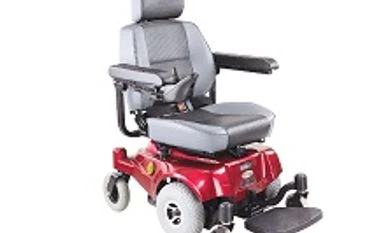 "New mind-controlled robotic wheelchairs developed")


 Connect with us on WhatsApp