Decrying “personality cult” as an anti-thesis of democracy, the Supreme Court today barred publication of photos of leaders in government advertisements except those of the President, Prime Minister and the Chief Justice of India.
A bench headed by Justice Ranjan Gogoi approved the suggestions given by a three-member committee on regulation of public advertisements, barring a few exceptions.
It rejected the stand of the central government that judiciary should not encroach into government policies and executive decisions and said that they can step in if there is no policy or law in place.
Acknowledging the fact that advertisements do contain pictures of politicians, the bench said, “...photographs, therefore, have the potential of developing the personality cult and the image of a one or a few individuals which is a direct antithesis of democratic functioning.” “The legitimate and permissible object of an advertisement can always be achieved without publication of the photograph of any particular functionary either in the state of a political party.
“We are, therefore, of the view that in departure to the views of the Committee which recommended permissibility of publication of the photographs of the President and Prime Minister of the country and Governor or Chief Minister of the State along with the advertisements, there should be an exception only in the case of President, PM and Chief Justice of country who may themselves decide the question,” it said.
The apex court also directed the central government to constitute a three-member committee “consisting of persons with unimpeachable neutrality and impartiality” to regulate the issue of public advertisements and rejected the plea that it should be done by the court itself.
Rejecting one of the recommendations of the Committee on the performance audit of award of advertisement to media houses, it said, “we do not feel the necessity of any such special audit inasmuch as machinery available is adequate to ensure due performance as well as accountability and proper utilisation of public money”.
“If Government advertisements adhere to the objects and parameters mentioned above, we do not feel the necessity of imposing a special curb on government advertisements on the eve of the elections, as suggested by the Committee,” the bench also comprising Pinaki Chandra Ghose said.
Advocating “neutrality of the fourth estate and freedom of press”, the court further said the governments must refrain from promoting and giving public advertisements to selective media houses.
“A connected facet of the matter which cannot be ignored is the power of the Government to give/award advertisements to selected media houses and the concomitant issue of freedom of press.
“Award of advertisements, naturally, brings financial benefit to the particular media house/newspaper group.
Patronisation of any particular media house(s) must be avoided and award of advertisements must be on an equal basis to all newspapers who may, however, be categorised depending upon their circulation,” the bench said.
The apex court said the Central and state governments bring out advertisements on completion of “a number of days, months and years of governance” in which the ‘achievements’ are highlighted.
“Though the achievements of a Government should not be a matter of publicity and really ought to be a matter of perception to be felt by the citizens on the results achieved, such advertisements do have the effect of keeping the citizens informed of the government functioning and therefore would be permissible,” it said.

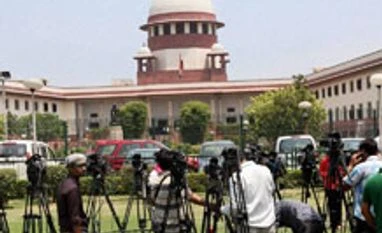 "Only photos of President, PM & CJI to be on central govt ads: SC")


