Home / World News / Solar Impulse waits out weather before take-off for Hawaii
Solar Impulse waits out weather before take-off for Hawaii
A solar-powered plane attempting to circle the globe without a drop of fuel was sitting in Japan waiting out unexpectedly bad weather after making an unplanned landing
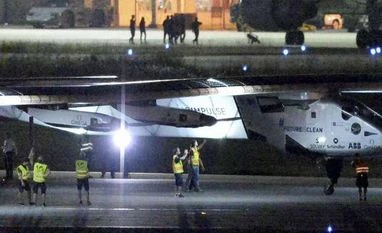
Nagoya Airport ground crew gather around the Solar Impulse 2 as it lands the airport in Toyoyama, near Nagoya, central Japan.
Ultimately when it comes to adventure, however advanced the technology, the weather holds the trump card.
A solar-powered plane attempting to circle the globe without a drop of fuel was sitting in Japan today waiting out unexpectedly bad weather after making an unplanned landing.
Swiss pilot Andre Borschberg took off from Nanjing, China, on Sunday, Saturday in Asian time zones, on what was to be the longest leg of the journey, a six-day, 8,175-kilometre (5,079-mile) flight to Hawaii.
But he had to land in Japan, and Bertrand Piccard, initiator, chairman and co-pilot of Solar Impulse 2, told the organiser's live feed, Solar Impulse TV, that the plane will continue its journey to Hawaii when the weather improves.
The team achieved its goal of the longest flight ever of a solar plane going through the night, he said.
"It's just the weather doesn't fit. Everything we could do has been done and was successful. What we cannot control is the weather. So we land in Nagoya, we wait for better conditions, and we continue," Piccard said.
The journey started in March in Abu Dhabi, and the plane has stopped in Oman, India, Myanmar and China.
The flight from Nanjing to Hawaii is the seventh of 12 flights and the riskiest since there is no place to land, so the pilot will likely wait a few days for the weather to change.
After more than 40 continuous hours of flying, the Solar Impulse 2 landed late yesterday at the Komaki airport in Nagoya, central Japan. Normally, the 1,700 kilometre (1,050 mile) trip would take less than three hours. But traveling at only 100 kilometres (62 miles) an hour, it takes much longer.
Borschberg spent about seven hours waiting to land, but the rest of the time was spent travelling from China. At the time he began his descent, his batteries were fully charged, illustrating the aircraft's ability to generate power while using it.
But at the time of landing, the plane's batteries were 74 percent charged, reflecting the extra energy required for landing.
Weather and nights pose special challenges for a solar-powered plane, said Claudia Durgnat, a spokeswoman for the Solar Impulse project.
A detour around a cloud consumes extra energy, but more importantly, the aircraft is not designed to withstand extreme weather.
"It does not take water or turbulence," Durgnat said.
At night, the aircraft must descend from its maximum altitude of 8,500 meters (27,887 feet) to 3,000 meters (9,850 feet) to minimise power consumption as it draws from its batteries.

 "Solar Impulse waits out weather before take-off for Hawaii")


 Connect with us on WhatsApp