Solar wind and radiation stripped the Martian atmosphere, transforming Mars from a planet that could have supported life billions of years ago into a frigid desert world, according to NASA scientists.
"We've determined that most of the gas ever present in the Mars atmosphere has been lost to space," said Bruce Jakosky, principal investigator for NASA's Mars Atmosphere and Volatile Evolution Mission (MAVEN).
The team made this determination from the latest results, which reveal that about 65 per cent of the argon that was ever in the atmosphere has been lost to space.
In 2015, MAVEN team members announced results that showed atmospheric gas is being lost to space today and described how atmosphere is stripped away.
The present analysis uses MAVEN spacecraft measurements of today's atmosphere for the first estimate of how much gas was lost through time.
Liquid water, essential for life, is not stable on Mars' surface today because the atmosphere is too cold and thin to support it.
However, evidence, such as features resembling dry riverbeds and minerals that only form in the presence of liquid water, indicates the ancient Martian climate was much different - warm enough for water to flow on the surface for extended periods.
The new result reveals solar wind and radiation were responsible for most of the atmospheric loss on Mars, and the depletion was enough to transform the Martian climate.
The solar wind is a thin stream of electrically conducting gas constantly blowing out from the surface of the sun.
The early Sun had far more intense ultraviolet radiation and solar wind, so atmospheric loss by these processes was likely much greater in Mars' history.
According to the team, these processes may have been the dominant ones controlling the planet's climate and habitability. It is possible microbial life could have existed at the surface early in Mars' history.
As the planet cooled off and dried up, any life could have been driven underground or forced into rare surface oases.
The team made its estimate using data from the Martian upper atmosphere, which was collected by MAVEN's Neutral Gas and Ion Mass Spectrometer (NGIMS).
This analysis included measurements from the Martian surface made by NASA's Sample Analysis at Mars (SAM) instrument on board the US space agency's Curiosity rover.
"The combined measurements enable a better determination of how much Martian argon has been lost to space over billions of years," said Paul Mahaffy of NASA's Goddard Space Flight Center in the US.
"Using measurements from both platforms points to the value of having multiple missions that make complementary measurements," said Mahaffy.

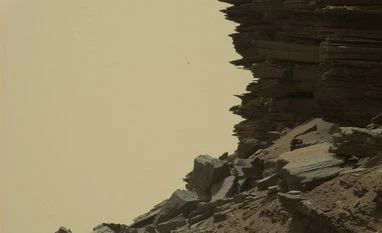 "Solar wind and radiation stripped the Martian atmosphere: NASA scientists")


 Connect with us on WhatsApp