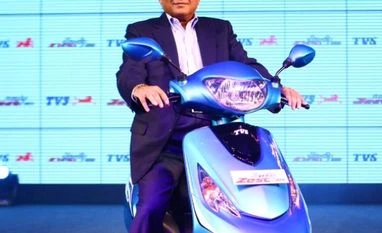
Venu Srinivasan, CMD, TVS Motor at the launch of Scooty Zest in Chennai
TVS Motor has added one more variant — Zest - to its 20 year old brand Scooty, which addresses young women customers. The company, which currently has a 15 per cent market share in the scooter segment, is expecting this to go up to around 18 per cent in the next three months.
TVS executives say Scooty Zest specifically targets young women in their college years or in their first job, between the age of 18-24s. The model has a nextgen 109.7 cc engine, sharing the same engine platform of TVS’s other scooter brands Wego and Jupiter, but offers a different fuel economy, features and price point.
Launching the Scooty Zest, Venu Srinivasan, CMD of TVS Motor, said new women customers need more power and are not willing to take a small Scooty anymore. “She wants equal opportunity, power and recognition and I think that is what the new Scooty is all about.”
The Zest is priced at Rs 42,300 ex-showroom in Delhi and in the first month the company is planning to sell over 10,000 units.
K N Radhakrishnan, president and CEO of the company, said the Zest will have more power, style, will be a little bigger and sharper and at a best mileage. The company has invested around Rs 70 crore in bringing up the Scooty Zest. The company has a capacity to manufacture around 20,000 units of the brand a month.
“The brand Scooty has become synonymous to the segment it addresses, so much so that many customers started calling all the scooters in that segment Scooty. That is the best brand recognition we can have,” said Aniruddha Haldar, head of marketing for scooters segment in TVS Motor.
“This is the second strongest brand in terms of its equity. With Zest, Scooty will become the strongest,” he added.
Scooty was first launched with only three brands. With the last brand updation of Scooty Pep Plus, Scooty is among the top five of the scooter segment in terms of volume. According to industry sources, in terms of volume, Scooty comes fifth, with Activa, Maestro, Jupiter and Pleasure in the first four positions.
“With this new product, among the top three or four brands, you will find TVS brands taking bulk of the number,” said Haldar. In terms of brand, Scooty is in the second position now, said Radhakrishnan.
The company’s scooter business is growing at around 54 per cent compared to the segment’s total growth of around 30 per cent.
The scooter industry has seen a sales of 3,01,175 units at 24% of the two-wheeler market last year whereas it has grown to 3,45,901 units at 26% now. The shift is due to the change in the conditions and the change in the macroeconomic situation.

 "TVS adds Zest to Scooty")


 Connect with us on WhatsApp