The UN has revised its flash appeal amount to USD 423 million to carry out humanitarian relief in the quake-hit Nepal, where eight million people require urgent assistance.
The global body has received just 10 per cent of the appeal amount even as the number of houses being destroyed has reached nearly 3 lakh, the UN said.
"As of May 8, Government said the earthquake destroyed 2,88,798 houses and damaged 2,54,112 houses," the UN's Office for the Coordination of Humanitarian Affairs (OCHA) said, adding 1,60,786 houses were destroyed by May 1, nearly double the number of households wrecked in the deadly 1934 temblor.
On April 29, the UN had appealed for USD 415 million in the wake of Nepal's worst earthquake in over 80 years which has been revised by eight million.
The April 25 quake measuring 7.9 on Richter scale has so far claimed nearly 8,000 lives and injured close to 16,400. Around eight million people have been displaced.
Sindhupalchowk is the worst-hit district where over 3,000 people died while over 1,200 killed in Kathmandu.
"Distribution of tarpaulins still remains a top priority with each household needs two tarpaulins. To date, 21 agencies reported a total of 69,909 tarpaulins, 11,624 household kits and 5,951 tents were distributed. Some 500,000 tarpaulins and 130,764 household kits are en route to Nepal," it said.
"Many Village Development Committees could not reach affected area due to inaccessibility both in terms of roads and communications," it said.
"A total of 240 primary health care centres and health posts were destroyed and 347 damaged in 14 districts. Three district hospitals were destroyed in Nuwakot, Rasuwa and Ramechhap districts," the report said.
Over 13,500 patients have been treated and 98 surgeries were performed by foreign military teams.
Israeli government which has set up a Military Field Hospital in Kathmandu said that eight babies were born in its makeshift hospital till May 8.
Besides, 9,50,000 children require education support.
Global humanitarian agencies like the International Federation of the Red Cross and Red Crescent Societies (IFRC) and Doctors Without Borders (Medecins Sans Frontieres or MSF) are providing critical medical relief by flying in mobile clinics in helicopters to remote areas or by installing inflatable hospitals in affected regions.
"The whole culture, centres of years of history on display have been blown away. And, these were not just buildings but also part of the psyche of the country... But, people of Nepal have shown great resilience and building back their lives," OCHA's Resident Coordinator in Nepal James McGoldrick said.

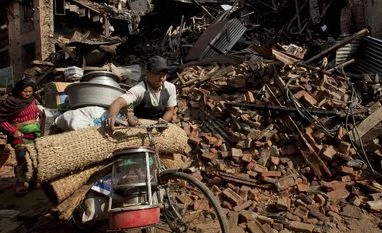 "UN revises appeal amount to $423 million for quake-hit Nepal")

