
Asian traders 'seasick' as UK votes for Brexit
Tight liquidity has widened the bid and offer gaps in the Asian credit markets, said traders
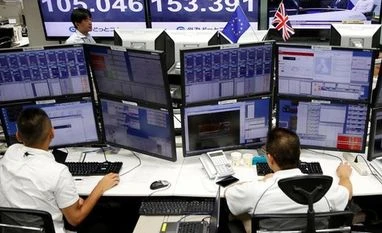 "Asian traders 'seasick' as UK votes for Brexit")
WebinarsNew
Deep DiveNew
Explore Business Standard
Tight liquidity has widened the bid and offer gaps in the Asian credit markets, said traders
Asian currency, bond and equity traders kicked off an early day of choppy trading as a British vote to leave the European Union sent shivers across trading floors, having kept many investors glued to their television screens.
Trading desks at most foreign banks from Hong Kong to Singapore opened on Friday nearly two hours before their normal start to take in early orders and address investor concerns, but the market meltdown and volatility ahead of the result pushed many traders to the sidelines.
Britain's bitterly contested referendum on whether to quit the EU began too close to call early on Friday, but the pound was hammered as the numbers slowly tipped in favour of a vote to leave.
"There will be a bloodbath on a lot of asset classes," said Andrew Ng, head of treasury and markets at Singapore's DBS Group Holdings Ltd .
The British pound fell about 10% to hit its lowest in three decades, shares in British bank HSBC plc tumbled 8%, while the FTSE index futures
"I am getting slightly seasick from the fluctuations between in and out," Michael Blythe, chief economist at Commonwealth Bank of Australia , said while the votes were being counted. "I haven't heard this much noise from the dealing room in a very long time," he added.
Forex markets were much more volatile and in Singapore some traders came in as early as 5 a.m. local Singapore time or even earlier to oversee the markets. Stephen Innes, a senior trader for FX broker OANDA Asia Pacific in Singapore, said he came to work at 3:30 a.m, much earlier than usual.
"I needed to do some minor adjustment on both hedging and pricing algos. I also adjusted some circuit breakers, given our anticipated views on market volatility. It's worth doing so to avoid issues later," Innes said.
The Malaysian ringgit's open level was quoted more than an hour earlier than usual. Some global banks were also arranging calls with their analysts to discuss the implication of the vote.
Volatile year
"Volatility has been the theme of the year, and people are getting used to it," said Danny Bao, chief investment officer at HJY Capital Advisors (HK) Ltd. "The big unknown is the complication that a Yes vote (to leave) will create for EU," he added.
Asian markets were first to open and react as the results vote count tricked in. By about 0500 GMT, with results declared from 374 of 382 voting districts, the Leave campaign had racked up enough votes to win, with about 52% of the vote.
"Liquidity generally is very light. Even before coming into the voting day, liquidity was generally light. The problem is the market was generally pricing in a 'remain', so obviously you're seeing the pound and currency markets generally recovering back to any risk-off level," one Hong Kong-based fund manager said.
"I don't think it's Armageddon day, but definitely it's a short-term surprise," the fund manager said.
Tight liquidity has widened the bid and offer gaps in the Asian credit markets, with very small lots going through in low volume trade. In the CDS market the iTraxx benchmark is trading at 142/145 bps, wider by about 8bps, and traders said it was one of the most volatile days of the year.
One bond taking a big hit was the HSBC 6.875% perpetual , down 4 points in price at 97.5/99. But some high-yield bonds are outperforming as it has caught bids from risk seekers. "We are seeing some support in high yield from investors rotating out of stocks," said a Singapore based trader.
Some traders are betting on a prolonged period of uncertainty.
"This was not anticipated by the market," said Patrick Bennett, CIBC Macro strategist, adding the result would lead people to unwind positions built on false optimism and price in new risks.
First Published: Jun 24 2016 | 10:42 AM IST


 Connect with us on WhatsApp