
Putin says Russia economy will be cured but offers no remedy
He said the actions of the central bank and government had been 'adequate' in a crisis he blamed on external factors
 "Putin says Russia economy will be cured but offers no remedy")
Explore Business Standard
He said the actions of the central bank and government had been 'adequate' in a crisis he blamed on external factors
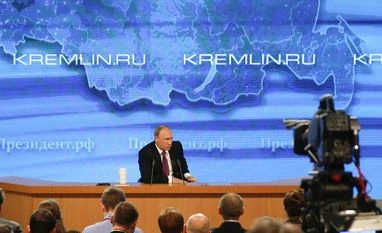
Under pressure to show he has a plan to fix the economy, Putin told an end-of-year news conference the actions of the central bank and government had been "adequate" in a crisis he blamed on external factors.
But hinting at internal divisions, he said more measures were needed and the central bank should have halted foreign exchange interventions to support the rouble sooner. Earlier, more decisive action by the central bank, he implied, might have made this week's big interest rate rise unnecessary.
The economy is heading into recession in what one minister called a "perfect storm" of low oil prices, Western sanctions in the Ukraine crisis and global economic problems. The rouble has fallen about 45 percent against the dollar this year.
"If the situation develops unfavourably, we will have to amend our plans. Beyond doubt, we will have to cut some (spending). But a positive turn and emergence from the current situation are inevitable," Putin said.
"The growth of the global economy will continue and our economy will rebound from the current situation," he said, sitting at a large desk and looking confident as he spoke to a studio audience and live on television.
He said Russia must diversify its economy to reduce dependence on oil, its major export and a key source of state income, and a recovery could start at some point next year.
But he stuck largely to broad promises rather than going into details and announced no major new proposals. He has said many times during 15 years in power that he will reduce Russia's reliance on energy exports but has failed to do so.
The rouble slipped as he spoke, moving to around 3 percent weaker on the day. The bank increased its key lending rate by 6.5 percentage points to 17 percent on Tuesday, and has spent more than $80 billion trying to shore up the rouble this year, but to little avail.
HEADS TO ROLL?
Analysts said Putin's assessment of the government and central bank's performance was lukewarm and could indicate that heads would roll.
"All this implies pretty big divisions within the administration as to how to react to the crisis and pressure on the rouble," Timothy Ash, head of emerging market research at Standard Bank in London, said in a note.
A prominent opponent, former Prime Minister Mikhail Kasyanov, said the crisis showed Putin had mismanaged the economy and his problems would increase because prices are expected to surge next year because of the rouble's weakness.
"Russia is going into decline," Kasyanov told Reuters in an interview late on Wednesday, suggesting Putin should accept that "he needs an exit strategy" to leave power.
Economy Minister Alexei Ulyukayev said in a newspaper interview the Western sanctions were likely to last "a very long time" and Russia was paying the price for failing to carry out structural reforms, describing events as "the perfect storm".
But Putin said: "Under the most unfavourable external economic scenario, this situation may go on for about two years. But it may also start improving in the first quarter, in the middle, at the end of the next year."
Opinion polls show Putin has high popularity ratings since annexing the Crimea peninsula from Ukraine in March, but the rouble's decline and Russia's slide towards recession could erode faith in Putin's ability to provide financial stability.
Asked about Ukraine, where Russia has irked the West by backing separatists fighting government forces in the east, Putin said Moscow wanted to restore political unity and denied any link between the conflict and Russia's economic problems.
He said he wanted the conflict, in which more than 4,700 people have been killed, resolved by political means. But he criticised NATO over its eastward expansion following the fall of the Berlin Wall and said Kiev had been wrong to use forces against the separatists.
First Published: Dec 18 2014 | 4:41 PM IST

