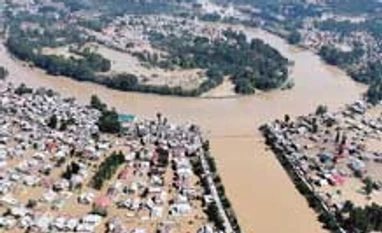
Floods leave J&K's small industry devastated
The water has receded at many places, but entrepreneurs may not be able to resume work this season
Komal Amit GeraVijay C Roy Chandigarh Small industry in the Kashmir valley has been devastated by the recent flashfloods, which have abruptly halted the operations of the tourism and handloom and handicraft industries.
The water has receded at many places, but entrepreneurs may not be able to resume work this season. Reconstruction and repair of buildings will need labour. Migrant workers, who return to their own homes in December every year, went back this year in fear of their lives when the flooding took place.
The months of May to December are the peak season in terms of tourist footfalls, but with mounds of silt having been deposited in the wake of the floods, the revival of tourism this season will be a challenge, said C P Gupta, the vice-chairman of the Jammu and Kashmir branch of the Confederation of Indian Industry.
The Federation of Hotels and Restaurants Association of India (FHRAI) is trying to persuade policy makers to take a variety of steps to revive tourism in the valley.
The president of FHRAI (north zone), Girish Oberoi, said that discussions were on with the Union ministry of tourism to provide interest-free loans to the affected entrepreneurs to rebuild their hotels, houseboats and restaurants.
A proposal is in the pipeline to make J&K a tax-free zone for the tourism industry. The FHRAI has also joined hands with the Federation of Associations of Indian Travel and Tour Operators to mobilise support for a tax concession on aviation turbine fuel to make flights cheaper to J&K, and thus attract tourists.
Entrepreneurs said that owing to the devastation there is uncertainty looming over industry. Finished goods as well as raw materials were destroyed when water entered factories and workshops. In addition, entrepreneurs' payments are stuck. They are also short of workers, especially migrants, who left the state in panic.
Naresh Aggrawal, proprietor, Jammu-based Kashmir Handloom & Handicraft Exports, said: "Most of the handloom and handicraft units in the valley were submerged in water, affecting the machinery, raw material and finished products."
He added, "Srinagar used to be a good market for handloom products, but things will take time to improve. Our payments are stuck, and so are those of other manufacturers. We have no idea what the future holds."
Pritam Singh Bedi, proprietor, Kashmir Handloom Industries, added, "With our payments stuck we don't have enough capital to rebuild our factories. Even if an entrepreneur plans to rebuild a factory by taking loans from friends, he doesn't have the workforce to execute the project."
"Secondly, May to December is peak season for the (handloom) industry. Since the industry is not in position to commence operations, the weavers will lose domestic as well foreign revenue, which will further affect the industry," he added.
The centuries-old handloom and handicrafts sector occupies a crucial position in the economy of Jammu and Kashmir. It is known for Pashmina shawls, Raffal shawls, silk sarees, Kishtwari blankets, chashme bulbul shawls, and cotton check bed sheets in Jammu and Kathua districts.
There are some 490 handloom cooperative societies in the state, with a membership of over 15,495 weavers. There are about 38,000 weavers in the state (including the organised and unorganised sectors), 70 per cent of them located in the Kashmir valley. In 2011-12, 16.95 million meters of handlooms worth Rs 385 crore was produced by the co-operative sector.
The main handloom clusters are in Srinagar, Anantnag, Budgam, Bandipora, Baramulla, Jammu, Kanihera, Poonch, Sopore and Udhampur.

 "Floods leave J&K's small industry devastated")


 Connect with us on WhatsApp