Ambassador Chronicles

As what makes the Ambassador such an indispensable part of India's cultural psyche
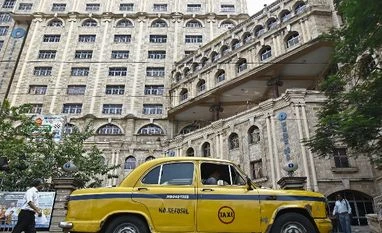
Ambassador, Amby, Kolkata, Taxi
A yellow Ambassador taxi in Kolkata.
Avishek Rakshit
Last Updated : Feb 18 2017 | 1:20 AM IST
In the early 1960s, industrialist S K Birla purchased an early model of the Ambassador, or Amby. It was round and robust, and spacious from inside. For a family trip to faraway Badrinath from Delhi, Birla requisitioned four Ambys instead of the rough and tough Jeep, the chosen vehicle for hill drives. The Ambys climbed the slopes without an effort and flew over the kuccha roads. 

However, one Amby’s steering unit broke down and the car stalled. Even as Birla was wondering what to do, the villagers guided him to a small garage that could fix it. “The Amby was so popular that people could repair and service the car anywhere in India,” Birla says.

One of his friends who had taken an American car for the trip suffered a breakdown midway and had to share a ride with Birla in his roomy Amby, the industrialist recollects.

Birla remained an Amby loyalist till recently when he finally decided to buy a Mercedes and then a Jaguar.
A yellow Ambassador taxi in Kolkata.
While the Amby appealed to Birla for practical reasons, it was a sign of socialist equality for West Bengal’s transport secretary, Alapan Bandyopadhyay.

Bandyopadhyay sees the Ambi as a symbol of “austere equality” as it was the vehicle of transport for the prime minister of the country as well as a junior bureaucrat. 

In the ’80s, the Amby, after becoming popular with ministers, was slowly making its way to the bureaucracy. Bandyopadhyay, 28, was made the sub-divisional magistrate of Chandannagore in 1989. SDMs, in those days, were eligible for a Jeep. However, women officers found it difficult to climb in and out of it and were therefore allotted the Amby. Bandyopadhyay’s predecessor happened to be a lady and that’s how his tryst with the Amby began.

“Over 20 years, which covers my youth, the Amby stayed with me. It was only recently that the government allotted me an SUV,” Bandyopadhyay says with visible nostalgia. “The Amby is a bygone era in the age of opulent cars.”

It carried the powerful and the commoner alike. Cabbies from Kolkata, who still drive the yellow Amby, share amazing stories of the car’s capabilities.

B Mondal, 63, who has been driving an Amby since 1981 recollects how the car once saved his life. In the late 1980s, Mondal was ferrying a passenger on a foggy winter morning on the highway when he found a bulky lorry just a few metres ahead.
An old Ambassador advertisement.
With just seconds to react, Mondal slammed the brakes and yet the car did not turn turtle. Although the bonnet was destroyed in the crash, Mondal suffered a minor chest injury and the passenger went unharmed. “Had it been any other car, that accident would have been the end of me and the passenger,” says he.

One thing that annoyed Mondal was that its gear often broke down and it meant not just a loss of earning but dwindling confidence in the car as well. In the pre-liberalisation era, when Indians had limited exposure to the world outside, he repeatedly heard stories of muscular American cars and sleek Japanese ones. This made him look at his rotund Amby, not dissimilar to a pregnant buffalo, with much disdain. In the early 1990s, he was ferrying a European couple from the airport to a hotel when one of the tourists, amazed by the car’s spacious interiors and the smooth ride, told him: “Tumhara gaadi accha hai (Your car is good)”. 

These words drove away all the disdain for his Amby. Though he could have switched to any other car, Mondal has stayed an Amby loyalist. 
An Ambassador in use in Rajasthan.
Designer Manish Malhotra gave himself a pink Amby, complete with kitschy interiors. In 2013, Top Gear voted the “indestructible” Amby as the best taxi in the world. The Amby remained popular with expats, who perhaps saw in it the stately visage of the Raj.

One subscription. Two world-class reads.

Already subscribed? Log in

Subscribe to read the full story →
*Subscribe to Business Standard digital and get complimentary access to The New York Times

Smart Quarterly

₹900

3 Months

₹300/Month

SAVE 25%

Smart Essential

₹2,700

1 Year

₹225/Month

SAVE 46%
*Complimentary New York Times access for the 2nd year will be given after 12 months

Super Saver

₹3,900

2 Years

₹162/Month

Subscribe

Renews automatically, cancel anytime

Here’s what’s included in our digital subscription plans

Exclusive premium stories online

  • Over 30 premium stories daily, handpicked by our editors

Complimentary Access to The New York Times

  • News, Games, Cooking, Audio, Wirecutter & The Athletic

Business Standard Epaper

  • Digital replica of our daily newspaper — with options to read, save, and share

Curated Newsletters

  • Insights on markets, finance, politics, tech, and more delivered to your inbox

Market Analysis & Investment Insights

  • In-depth market analysis & insights with access to The Smart Investor

Archives

  • Repository of articles and publications dating back to 1997

Ad-free Reading

  • Uninterrupted reading experience with no advertisements

Seamless Access Across All Devices

  • Access Business Standard across devices — mobile, tablet, or PC, via web or app

Next Story



