Art of the business

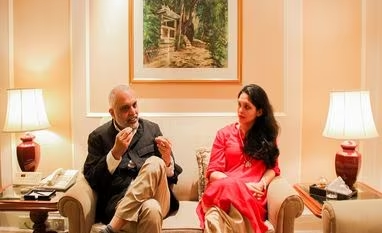
Hari Bhartia and Swati Apte in conversation with Pronoti Apte
pic
pic
Pronoti Dutta
Last Updated : Jan 07 2017 | 12:07 AM IST
Hari Bhartia, co-chairman and founder of the Jubilant Bhartia Group, and Swati Apte, co-founder of The Arts Quotient and a core team member of Strategic Management in the Art of Theatre (SMART), discuss how the arts unleash creativity in business. Pronoti Datta moderates the conversation.

Pronoti Datta: How we can create space for the arts in a more meaningful way than it exists today? 

Hari Bhartia: Socially, if you’re growing up in a city, while you need work spaces and connectivity to (get to) work, you also have to have a family life. Somewhere you yearn for art, culture. You want to have leisure not only to go to a pub for a drink but you also need to have spaces where you will see a performing art or even art in public spaces, which are more democratic, not an exclusive kind of gallery where you buy expensive art. Some cities have tried that effectively to bring theatre into public space. Delhi is starting to see that, in terms of Nehru Garden, where you have open air performances of music. Like (Sufi music festival) Jahan-e-Khusrau happened in Delhi through private efforts. But more than that, you need to plan at least some spaces to be given away for arts. 

PD: Now we’re seeing some corporate involvement in the arts that goes beyond sponsorship. 

HB: Normally there’s so much more CSR work that corporations want to do in the areas of  and education. Corporate understanding about the arts is limited. How do we invest in art which could impact a larger set of people? It’s tough because sometimes you can be perceived as doing some elitist work. So I feel theatre is very impactful as it would include more number of people. 

Swati Apte: Hari alluded to the perception of arts. Because usually you imagine it in a box — a gallery or auditorium — in a closed space. With that comes this notion that it’s elitist. So, for corporates to support it, (it should be acknowledged) that the arts or any kind of live engagement has always historically been critical to how communities have been engaged. If you think about that in the context of urban design, then it becomes necessary not just to think of the physical structures but also to think about what is that ongoing engagement that makes those spaces used. Say, a place like BKC. You have all these office buildings, huge lobby spaces. I can imagine a world in which once a month you open that out — one lobby has a film screening, another has a play, something else has music. When you begin to think of the arts like that, then even for corporates to put CSR investment in that makes sense, because then it becomes a community engagement thing to do. 

PD: Have you experienced theatre impacting the way people do business?

HB: Absolutely. You want your workspace to be fun and we are trying to bring in that emotional quotient in business. That process can happen through engagement with art. People who are in business sometimes feel that innovation and creativity is not required in the work that they do. But, in all the things that we do, we require innovation, creativity, a bit of emotional sense. 

PD: Is it something you try to do in your own organisation? Make things fun?

HB: We try. Annually, we have a meeting with our 1,400 store managers in our pizza business. The amount of theatrics that goes on the stage! In terms of understanding what our strategy is, you need to marry it with fun. Today’s youth — any communication that you want to do, if you do it with a sense of emotion, it (goes) much deeper than if you just give him a lecture about strategy. That’s why you find that a smaller company, where five friends get together and try to create a new product, they are so passionate, they work together, they have a drink together, they go out and see a play together. They are much faster in innovation. Larger companies find it difficult to innovate. 

PD: At SMART, on the other hand, you’re trying to teach theatre people to adopt certain business-like practices.

SA: We’re trying to get them to adopt a strategic management approach, and I think perhaps because business has done it for a long time, it’s associated with business. But frankly, a homemaker has to manage strategically. So it’s just a certain discipline, a rigour and a process in which you do your thinking and make choices between multiple things that you have. And, I think for theatre groups, when you work with limited resources, it’s all the more vital. SMART is about is a different process of thinking. Are you still remembering and thinking about what it is that you want to achieve in the long run, defining what that means you have to do in the short run? 

SMART is run under the aegis of the India Theatre Forum, and managed by Junoon Theatre andIndia Foundation for the Arts

One subscription. Two world-class reads.

Already subscribed? Log in

Subscribe to read the full story →
*Subscribe to Business Standard digital and get complimentary access to The New York Times

Smart Quarterly

₹900

3 Months

₹300/Month

SAVE 25%

Smart Essential

₹2,700

1 Year

₹225/Month

SAVE 46%
*Complimentary New York Times access for the 2nd year will be given after 12 months

Super Saver

₹3,900

2 Years

₹162/Month

Subscribe

Renews automatically, cancel anytime

Here’s what’s included in our digital subscription plans

Exclusive premium stories online

  • Over 30 premium stories daily, handpicked by our editors

Complimentary Access to The New York Times

  • News, Games, Cooking, Audio, Wirecutter & The Athletic

Business Standard Epaper

  • Digital replica of our daily newspaper — with options to read, save, and share

Curated Newsletters

  • Insights on markets, finance, politics, tech, and more delivered to your inbox

Market Analysis & Investment Insights

  • In-depth market analysis & insights with access to The Smart Investor

Archives

  • Repository of articles and publications dating back to 1997

Ad-free Reading

  • Uninterrupted reading experience with no advertisements

Seamless Access Across All Devices

  • Access Business Standard across devices — mobile, tablet, or PC, via web or app

Next Story



