“I always like to keep a buffer of a day before the exhibition starts to make last-minute checks because one trip over a wire and poof, it’s all gone,” says 68-year-old Nalini Malani while sipping green tea. We are seated in the warmly-lit conference room at the Kiran Nadar Museum of Art, or KNMA, in Saket in New Delhi where she is busy putting the final touches to the exhibition, You Can’t Keep Acid in a Paper Bag. This is the third and final chapter of the first ever Indian retrospective on the artist’s works from 1969 to 2014. Over 50 years she has created a series of haunting works to interpret the complex issues of conflict, identity and gender.
The exhibition is spread across three rooms with some works such as Transgressions III (2001/14) and Twice Upon A Time premiering exclusively at KNMA. The first room is home to City of Desires, the ephemeral wall drawing that Malani made in 1992. She captured this on video at the suggestion of friend and writer Ashish Rajadhyaksha, who was keen that she document this ephemeral wall drawing. It started when a collector friend took her to an akhada in Nathdwara whose facade and interiors were adorned by murals . “But they were all getting covered in soot as the Goswamis there cooked in the complex. It was the time of the rath yatra, which was supposedly about preserving Hinduism and yet the most beautiful aspects of the culture were getting destroyed,” says Malani. So she created an ephemeral wall drawing for Gallery Chemould in Mumbai — this drawing would be destroyed at the end of 15 days, relegating the artwork to memory. “Memory has always played an important role in my artwork,” says Malani, whose work has been deeply influenced by her experience as a Partition refugee.
Also on display is the Hieroglyph series that she made in 1991. These 30 books were made by a technique she calls “cloning”. Monoprints were photocopied and worked on with different mediums — ink, charcoal, watercolour, pen and collage. “The studio then was in Mumbai’s Lohar Chawl, where you could see the archaeology of society,” she says. She could see the pavement dwellers who were engaged in different activities — women working as recyclers of paper and the men carrying high-tech gadgets to the electricals market. On the other side was the Hanuman Mandir. Beggars would line up for alms but never the pavement dwellers. “They maintained dignity even in poverty. There was also a shauchalaya in the area that got its daily water supply every morning from a tanker. These pavement dwellers had a deal with the tanker for their share of water. So I made a whole series on how water was collected,” she explains.
While one glances at these books, made and bound by Malani, a haunting voice keeps echoing from the neighbouring room. A little girl keeps repeating: “I speak orange, I speak blue, I speak just like you.” This is Malani’s sensory installation Transgressions. It consists of three videos that are projected through four transparent Lexan cylinders that the artist has painted on. “I grew up in the post colonial situation where there were only two cars — the Ambassador and Fiat — and you had to wait for five months to get a phone connection. But with liberalisation, new products brought in new desires and a chronic hunger for things you didn’t need,” she says. In the same room is a drawing of Medea and a recently-finished artwork, which is part of the global parasites project to make the invisible visible. “Invisible people like labourers are being taken to West Asia to make maximum cities but they can never partake of those luxuries,” says Malani.
The third room also features a new work — Twice Upon A Time — a multi panel painting installation. Malani feels that patriarchy is going in a destructive direction without the temperance of the feminine voice: “We must not forget a free woman is a free man.”
You Can’t Keep Acid in a Paper Bag is open to public till November 30

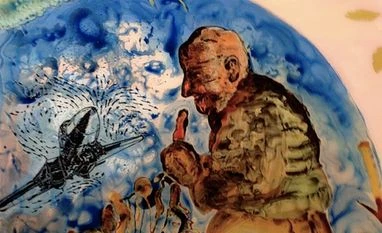 "Artist Nalini Malani reimagines society")


 Connect with us on WhatsApp