I have always believed that one of the best ways to enjoy the monsoon is to experience it in the desert. When the arid terrain, parched dry by an unforgiving summer, is moistened by the rains, the transformation of the landscape is magical. I feel this as we explore the many
kuccha paths among the wetlands of Keoladeo National Park in Bharatpur. Having seen it in the height of the summer when much of its wetlands had dried into clayey fissures, it's as if the rains have enlivened and revitalised its landscape. Most serious birders prefer to visit this place in winter, when huge populations of migratory ducks, geese, pelicans and waders can be seen here. It is, however, during the monsoon that it is at its most welcoming, with lush greenery, abundant life and the all-pervasive fragrance of the wet earth.
It's just after 6 am. As we walk past the morning walkers towards the entry gates to the Park, we're greeted by the scores of
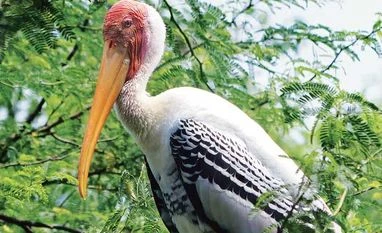
rickshaw-waalas waiting to take visitors inside. There are cycles on hire too, and consequently, the vibe on the paths of Keoladeo is generally slow. Every now and again, water glints through the lush foliage. A turtle's weathered, leathery back momentarily comes into view as it swims past some painted storks. The birds are huge, and so many of them are sitting on a single tree that I fear it might snap under their weight. Just then a flock of black cormorants joins the storks on the same tree. Some ratchet tailed drongos crash the party, swooping among the branches with their graceful tail feathers trailing behind. Soon, there are more birds than tree. Why have different species chosen this particular specimen over others nearby, I wonder. The guide either knows too little or too much. He replies that the birds simply do what they must do.
A night jar calls. We spot it with difficulty - a little brown bird camouflaged against the trunk of a tall tree. This is the season for it to breed, I read in my field guide, and that's why the nocturnal bird is active during daytime. Paths crisscross the main road and we try and explore each one of them. But Keoladeo Park, or
Ghana as it is locally known (the name means thicket, to signify the denseness of its forest cover), is 29 sq km in area, so we call it a day as the sun sets, planning to return early next morning.
At the hotel in the evening, we learn that Keoladeo Park, home to 366 bird species, was once the hunting ground for the
maharajas of Bharatpur. It is said that in a single shoot in 1938, over 4,273 birds were shot by Lord Linlithgow, the then governor-general of India. All this changed after Independence, when Salim Ali, India's bird man, was able to bring pressure to convert the area into Keoladeo National Park. Today, the site is a man-made and man-managed wetland with waterbodies and marshes of varying depths.
The first animal we sight the next morning is a jackal, guarding its young ones in a mud nest in the grasslands. As the grasslands give way to a marshy tract, we spot a pair of sarus cranes. Natives to Keoladeo National Park, these large birds breed during the rainy season, building large raised nests over shallow water.
We meet some American birders who've been exploring the forests for a week now. "There's just so much to see," says one of them. "And this is not even considered the best season for birding here!" Therein lies the mystique of Keoladeo National Park. "This is the only bird sanctuary where there is some water throughout the year," says Surya Prakash, noted birding enthusiast and professor at Jawaharlal Nehru University. "So there are always interesting birds and reptiles to see here." He points out that so far, the Keoladeo ecosystem is quite well-balanced. "The population of small birds is kept under check by the crested serpent eagles that prey upon them," he says. Rock pythons keep the duck population in balance as they love to dine on their eggs and chicks. But the balance is fragile and already shows signs of disturbance, worsened by the fact that this is the only national park with no buffer zone to act as, well, a buffer.
A flock of painted storks lands in perfect unison on a tree, their coloured wings looking as if they've stepped out of an impressionist painting. Some tourists get too close, and they rise up again in a graceful arc. A few years ago, these storks were forced to abandon their nests because of increased human activity. Siberian cranes, Keoladeo's most famous migrants, were last spotted in 2002. As we leave, I cast a final look at this monsoon wonderland, hoping that when I see it again, it is in better, not worse, shape.

 "Keoladeoscope")


 Connect with us on WhatsApp