
States with worst sex ratios have most female MLAs
The top five states of India with the highest percentage of women MLAs (members of legislative assembly) are also states with the worst sex ratios
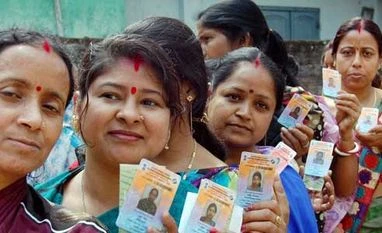 "States with worst sex ratios have most female MLAs")
WebinarsNew
Deep DiveNew
Explore Business Standard
The top five states of India with the highest percentage of women MLAs (members of legislative assembly) are also states with the worst sex ratios
States with poor development indicators for women (mainly sex ratio and female literacy) have higher representation of women in their vidhan sabhas (legislative assemblies) according to an analysis of Census and Election Commission data.
The top five states of India with the highest percentage of women MLAs (members of legislative assembly) are also states with the worst sex ratios.
The female literacy rate in three of these states is lower than the national average of 64.4%. The northern states of Haryana and Punjab, known for their poor female sex ratio, have higher literacy rates than the national average.
Political empowerment, an important indicator of gender development, does not necessarily correlate with better development indicators for women.
Source: Election Commission, Census of India 2011
Bihar sees surge in women MLAs
There has been a surge in the number of women MLAs in Bihar since the 2000 elections, as IndiaSpend and GenderinPolitics reported earlier.
From 5.9% in 2000, women made up 14% of the Bihar vidhan sabha after the 2010 election, the highest proportion of women in any Indian state assembly.
The number of women contesting elections in Bihar has increased 62% since 2000, while the number of constituencies they contested from increased 33%.
Female MLAs concentrated in northern Bihar
In the currently dissolved vidhan sabha, women represented 34 constituencies spread over 22 districts. In 16 districts, no constituency was represented by a female MLA.
The districts of west Champaran, Sitamarhi and Patna have the highest number of constituencies (three each) represented by women. East Champaran, Supaul, Siwan, Begusarai and Purnia have two constituencies each represented by women; 15 districts have one constituency with a female MLA.
Source: Election Commission of India, Districts of India
In Supaul, west Champaran and Sitamarhi, a third of constituencies were represented by women. Most of these districts are contiguously located in northern Bihar.
Constituencies that elect female MLAs tend to re-elect them
Another interesting pattern is that any increase in women MLAs has almost always been in these districts in the last two elections, 2000 and 2010.
Source: Election Commission of India
Between 2005 and 2010, Bihar elected nine more women MLAs, all from the constituencies in districts we mentioned above. West Champaran and Begusarai had two more constituencies than the previous year that elected women MLAs.
Low sex ratios and literacy in districts that elect female MLAs
Apart from geographical proximity of these districts, another striking feature of these districts with the most female MLAs is their low sex ratios and literacy rates.
Source: Census of India 2011
The overall sex ratio for Bihar is 916, against the national average of 940.
Except Siwan, Supaul and Purnia, rest of the districts with female representation are way below the state average.
Bihar has India’s lowest literacy rate at 63.5% and the lowest female literacy rate at 53%. Most districts fall short of the state average for female literacy.
West Champaran and Sitamarhi, which have the most constituencies with women MLAs, have poor sex ratios and low literacy rates.
So, do districts with poor development indicators elect more women? In Bihar, that certainly appears to be the case.
(IndiaSpend is a data-driven, public interest journalism non-profit)
Although the causal factors are unknown, the correlation, in Bihar’s case, is evident, which corroborates the larger pattern seen in many states with a high proportion of female MLAs and low human development indicators.
First Published: Sep 28 2015 | 10:31 AM IST


 Connect with us on WhatsApp