Statsguru: Tracking political funding
51% of total donations to National Parties came from donors whose details are not available
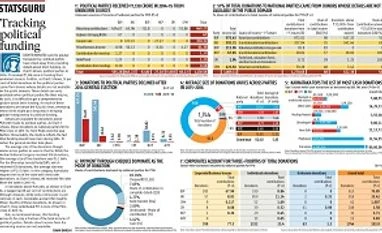
Ishan Bakshi Despite repeated calls for greater transparency, political parties have shied away from providing details about their funding. As Chart 1 shows, political parties in 2014-15 received Rs 1,130 crore in funding from unknown sources. Further, as Chart 2 shows, 51 per cent of total donations to five political parties came from donors whose details are not available in the public domain. These details are only available when political parties file their returns. As such, it is difficult to get a comprehensive picture about their funding. As much of these donations are below the Rs 20,000 limit, reviewing these limits might go a long way in bringing greater transparency in political funding.
Details are available for donations above Rs 20,000 made to political parties. As Chart 3 shows, these donations to national parties fell to Rs 102 crore in 2015-16, from Rs 630 crore the year before. Presumably, the decline reflects the fact that funding would have risen during 2014-15 when the general election took place.
The average size of the donations though varies across parties as seen in Chart 4. While the Indian National Congress received 918 donations, the average size of the donations was Rs 2.2 lakh. For the Bharatiya Janata Party (BJP), which received 613 donations, the average size was higher at Rs 12.53 lakh. In this category, Karnataka topped the list of the state with most cash donations. As Chart 5 shows, INC received Rs 80 lakh from the state in 2015-16.
In donations above Rs 20,000, as shown in Chart 6, a staggering 88 per cent of contributions are through cheques, while only a minuscule 1.4 per cent are in cash. Corporates account for roughly three-fourths of these donations. As shown in Chart 7, they contributed Rs 77.3 crore of the Rs 102-crore in 2015-16.
But, as mentioned above, this funding accounts for only a fraction of the total income of political parties. Details about income from the remaining sources are not available.

 "<b>Statsguru:</b> Tracking political funding")


 Connect with us on WhatsApp