The Taj Group’s collection of paintings by modern Indian artists is one of the largest in the country with about 1,000 original paintings, including 200 masterpieces and 3,000 prints. While most of the works are displayed in the flagship property of the Taj Mahal Palace in Mumbai, the Taj Mansingh Hotel in Delhi has a fairly extensive collection, too.
Since the 1960s, the group has followed a tradition of buying, promoting and building close relationships with upcoming artists. As Delhi-based art critic and curator Gayatri Sinha says, “While most Indian corporations have been largely indifferent to art, the Tatas stand out for having made the right investments in art at the right time.” There was a time when the Taj was a central hub for Indian art, and until the early 1990s, the Taj Gallery was one of the few places where admirers and collectors could visit and buy contemporary art.
Though the Taj Gallery shut down about 10 years ago, the group still buys from exhibitions, galleries and auctions. It also commissions artists for exclusive artworks, such as the panel in the new lobby at the Taj Mumbai that M F Husain created especially for the hotel.
In Delhi, the contrast in décor and approaches to art in the Taj properties at Chanakyapuri and Mansingh Road is fairly obvious.
The Taj Palace at Chanakyapuri has an entrance that looks like something out of The Arabian Nights, with chandeliers, a tent-like lounge and reproductions of miniature paintings. Although it has works by a few well-known artists, such as Sanjay Bhattacharya, displayed in the foyer, most of its original paintings and sculptures are displayed in its Art Suite. Artists such as Arup Das, P Chaturvedi and Ajit Seal are featured here. Every week in its Tea Lounge, the hotel also hosts and sells the works of a different upcoming artists such as Saurabh Mohan.
The Taj Mansingh, in contrast, displays the works of over 30 well-known Indian artists. This includes masters such as Anjolie Ela Menon, Husain, Manu Parekh, Jamini Roy and Ram Kumar.
One word that characterises the Taj Mansingh collection is restraint. Many of these paintings are discretely placed on the walls of the Club Lounge, including an Menon that is hidden behind the door of a meeting room nearby. There is also a series of caricatures by R K Laxman on the walls outside the lounge, depicting personalities such as Ravi Shankar, Khan Abdul Ghaffar Khan and Jawaharlal Nehru.
But the most striking piece at the Taj Mansingh is the Menon mural that stretches across an entire wall of its signature restaurant, Varq. She painted it in 1979, though it was restored in 2007. Menon insisted on restoring it herself, to the surprise of her assistants.
The Chambers with caricatures by R K Laxman
The Taj’s policy of art restoration has ensured that the domes in the white marble lobby of the Taj Mansingh look new, although they were specially cast in 1970. The doors and windows displayed are 19th century relics with gold inlay work from Shahjahanabad, the capital of Mughal Emperor Shah Jahan. There are also huge Nepalese milk jars and talismanic water bowls covered with Persian and Arabic religious couplets that were believed to impart curative powers to the water.
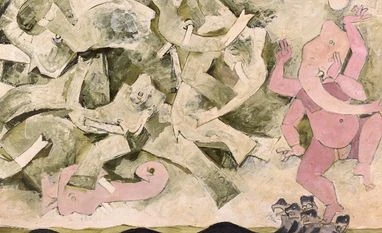
“Art is ensconced in rooms of intimate grandeur,” says critic and curator Uma Nair. “My personal favourites are the Husain and the Reddapa Naidu. The Husain”, she explains, “is a mythic hybrid with the shesh nag and the pastel palette that lends itself to an early period of ‘Husainesque’ versatility. The Naidu breathes the beauty of ritual in the quasi abstract shadings of the god who resides in zones of resonant tonality”.
Untitled work by M F Husain at the Taj Mansinghl Hotel, New Delhi
The Taj started the collection as a way to give young artists a chance to showcase their works. Some of them went on to become masters and the collection today is priceless. We, however,get to bask in the warmth of these collectors who preserve these works for us to enjoy.

 "Stay at the Taj Hotel with M F Husain and Jamini Roy for company")

