Yusuf Arakkal, who died this week, did not come from a penurious background as so many of his peers did, but fortune was not kind to him either. On occasion, when he was in a mood to reminisce, he spoke of running away from home and living on the streets of Bengaluru, where he slept on pavements and held menial jobs. (The royal Kannur family of Malabar, into which he was born, could be patrons, not suppliers, of art.) Arakkal apprenticed at Chitrakala Parishath in the city and followed it up with a stint as a printmaker at Garhi Studios in New Delhi. His rise to fame in Bengaluru charted his career, and he went on to emerge as one of the more powerful artists from India's south, a practice he accentuated with the opening of a gallery in his wife, Sara Arakkal's name, to promote talent from the region.
Arakkal's paintings have the haunting quality of Bikash Bhattacharjee and the abstract displacement of Rameshwar Broota, though he claimed Western artists as his influence. He combined the effect of photo-realism with the abstract to deconstruct brooding images steeped in melancholy that stayed with you long after you had stepped out of a gallery. In recreating repetitive figures, he cast light on the marginalised - not in a sense of privilege or caste - but those isolated by society, such as he found himself as a young adult. The child or young adult in his paintings could have been a metaphor for himself, but he was above such indulgence, and his works depicted social conditions too often ignored by other artists.
Arakkal worked the entire gamut of artistic practices ranging from his first love, painting, to sculpture (somewhat less successfully), mural making and installations. He was extensively shown from the 1980s onwards, though he had slowed down in the last years. His greatest support in Bengaluru was collector Kiran Mazumdar-Shaw, and he talked often of her mentorship not only of him and his work but of other artists as well. To that extent, Arakkal was selfless; he was not competitive either as far as his fellow artists were concerned, somewhat content in his own space, though he continuously challenged himself when it came to creating art and finding the appropriate home for it.
This is where his unfulfilled dream lay incomplete. He had been working on a series of Christ paintings for a few years that he wanted shown at the Vatican; indeed, he called often to talk about the project, and also inveigled me and a few other writer friends to contribute texts for it. He would occasionally send images of works he had completed, and was frustrated by what he believed to be unnecessary hurdles and delays.
He was also a perceptive writer-artist, somewhat of a rarity in India. With exceptions such as F N Souza, or J Swaminathan, or scholars such as Gulammohammed Sheikh in the academic space, Arakkal filled a void in the mainstream media. He would sometimes send links to his writings; occasionally call from Bengaluru just because he wanted to talk about things of relevance and irrelevance. His health was fading, that much was clear, but he would urge me to look at his son Shibu Arakkal's photographs. Ultimately, his was the voice of the artist in exile in his own studio, about which he wrote in his poem, The Painter: Crammed, dirty palette Colours huddled together Yearning to stretch Spread on to each other …losing identity
The paints may have lost their identity but Arakkal never lost his way. Collectors, however, will have their task cut out finding their way to it.
Kishore Singh is a Delhi-based writer and art critic. These views are personal and do not reflect those of the organisation with which he is associated

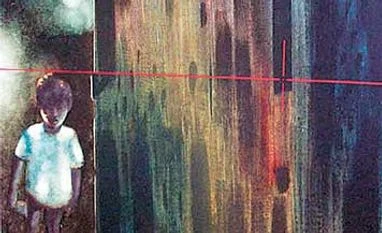 "The artist in exile in his studio")


 Connect with us on WhatsApp