Around the time that William Shakespeare was flourishing as a playwright in England, another dramatist, Tang Xianzu, was making his mark closer home. Tang, a Chinese playwright during the Ming Dynasty, wrote four major plays, the most popular of which, The Peony Pavilion, is coming to India for the first time.
First performed in 1598, The Peony Pavilion is recognised by UNESCO as one of the masterpieces of the Oral and Intangible Heritage of Humanity and is hailed as the “mother” of a hundred opera forms. In its original form, the play, traditionally performed as a Kunqu opera, which is one of the oldest styles of Chinese theatre, runs for 20 hours and has 55 scenes. “When I first saw The Peony Pavilion at the Lincoln Centre for the Performing Arts [in New York], it was a 19-hour production,” recalls Swati Bhise, the Bharatnatyam dancer and artistic director of the Bravia Sadir Theatre Festival, who is bringing the opera to India. “It was a sellout. That was the first time this opera had come out of China.”
What we’ll get to see in India, however, is a much tighter version of the magnum opus. The play has been brought down to a 90-minute performance of key scenes without compromising on its essence. The idea is to introduce the Indian audience to what is rated as one of China’s best-loved classical operas.
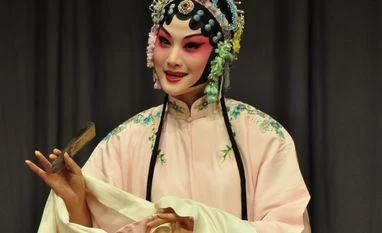
A sophisticated, stylised and lyrical opera, Kunqu was meant for the connoisseurs — for the emperor and his entourage. Much like Indian classical dance forms, it requires years of study and training before it can be performed. There is extensive use of what is called the ‘water sleeve’, where the flowing sleeve of the robe is used to express emotions. As in Kathakali, the faces of different characters — male, female or the clown — are painted differently.
Zhang Yuanyuan as Du Liniang
The Peony Pavilion is a complicated love story set in the last days of the Southern Song Dynasty, which lasted from 1127 to 1279 AD. A maid persuades Du Liniang, the 16-year-old daughter of an important official, to take a walk in the garden where she falls asleep and, in her dream, encounters a young scholar, Liu Mengmei, whom she has never met in real life. A flaming romance ensues. The girl’s dream is interrupted by a flower petal falling on her. She wakes up, but becomes so preoccupied with her dream affair that her lovesickness consumes her and she dies. In the underworld, the judges decide that a marriage between Du and Liu is destined and that she ought to return to the earthly world. Liu too falls in love with the dead girl who appears in his dreams and exhumes her body. She is subsequently brought back to life. Certain other complications follow and the play takes more twists and turns.
“I thought the story was a lot like Romeo and Juliet. So, in a way, I am trying to connect to our Indian sensibilities of growing up on Shakespeare,” says Bhise. And yet, it’s Chinese. If there are traces of Shakespeare, there are also elements of rasa as we see in Indian classical dance forms. “The very concept of being in the garden, seeing the flowers and the bees is like Radha walking during Basant (spring), thinking about Krishna and pining away for him,” says Bhise who will be performing a Bharatnatyam dance alongside the opera to a select audience at Delhi’s Gymkhana Club to depict the similarities between the two dance forms.
The play will be staged by 18 performers, all from mainland China. It has been translated by Joanna Lee, an American-Chinese who has spent a lifetime on operas. “Lee’s mother was, in fact, a Kunqu opera performer,” says Bhise. The translation, which will capture the essence of what is being said on stage instead of merely dubbing the words, will be displayed on two LED screens in the auditorium.
The Peony Pavilion will be staged at the National Centre for the Performing Arts, Mumbai, on December 9; and at Siri Fort Auditorium, Delhi, on December 12. Tickets on BookMyShow

 "The Peony Pavilion: With (ancient) love from China")


 Connect with us on WhatsApp