Vadnagar’s lanes are not only narrow but are also on an incline. As I climb up and down its intricate network of lanes with open drains running alongside, the old-world charm of an unplanned town begins to grow on me. While most of the houses have been renovated, done up in bright colours and concrete, some still retain their old architecture: long wooden windows, no balconies, steep wooden stairs, and at times a small courtyard in the front. All houses are attached to one another with absolutely no space in between. The centre of activity is the town square filled with vendors, people reading newspapers, kids running up and down the steps that lead to the Sharmishtha Lake. It is difficult to imagine that this was in ancient times the capital of the Gujarat kingdom. The Puranas mention it as a flourishing city. Locals say the town is built on a tekra (mound) and buried below their feet are structures built and destroyed innumerable times in the last 4,500 years.
In spite of its ordinariness, Vadnagar has all the trappings of a newly-discovered tourist town. The buzz created by the hope that busloads of tourists will soon descend here is unmistakable. Everybody seems to have some Narendra Modi trivia ready for you. “Once we had asked our teacher why this town did not prosper, and he had said that one day a son of the soil would become the prime minister of the country,” recollects Poonam Khan Pathan who claims to be a classmate of Pankaj Modi, the brother of Prime Minister Modi. Another schoolmate, Dasrath Modi, remembers Modi was reading the biography of Shivaji when the parents of Jashodaben (his estranged wife) came to leave her at her husband’s home. “Harish Patel, one of our friends, who was very talented, played cricket, dabbled in astrology and even played the flute, had predicted that Modi would become a leader of national stature. Patel is now a hermit in the Himalayas,” he adds. Modi, he remembers, argued with Patel in disbelief: “How can you say such a thing? I am a poor tea seller, how can I become a national leader?”
When I look around for Modi’s modest house that has been written about so often in recent months — a short graphic novel called Bal Narendra (designed by Blue Snail Animation and published by Rannade Prakashan, both of Ahmedabad) shows it as a modest house with roomy interiors, the plaster peeling off the walls, and the only material possessions of the family appear to be a hand-operated flourmill and a cot — a surprise awaits me. The Modi family had long ago sold its home and D D Thakur now lives here. He has renovated the house and converted it into a two-floor building. Locals refer to it as a bungalow, though the house is hardly 10 feet wide. The reticent Thakurs are a rare exception amongst the over-enthusiastic neighbours and are not keen to talk to strangers. Hasmukh Prajapati, who runs a grocery store right in front of the house, fills in with the details even before you ask, “Pankaj Modi had sold this house years ago when the family moved to Gandhinagar. Modiji visited this place a couple of times after he became the chief minister to meet his mother, Hiraba,” he says. Prajapati is fond of Hiraba. “She literally brought us up,” he claims.
The building that has come up in place of the house where Modi was born and brought up
The streets of Vadnagar surprisingly do not flaunt many Modi pictures, though flags with Bharatiya Janata Party’s lotus symbol can be seen here and there. The chowk near Modi’s house carries some decoration from the night’s festivities after Modi took oath as the prime minister. According to locals, many party workers had congregated to burst crackers and distribute sweets, though none is visible today. A second round of festivities is planned for later, when a havan will be held at a nearby temple and over 500 people will be fed.
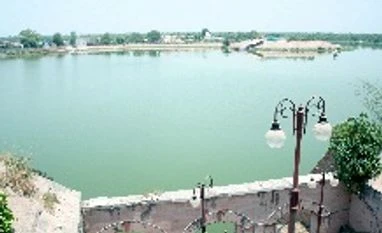
Not far from the house is the Sharmishtha Lake. A few vendors sell fruit juice in the sweltering 46-degree heat. But that didn’t stop locals from doing the garba yesterday. The lake has been made famous by Bal Narendra as well as Paragati Purush Narendra Modi (Raj Chitra Katha) as the site of Modi’s first heroic feat. While Bal Narendra says he jumped into the crocodile-infested waters to save a friend from drowning, the other graphic novel says he swam in it to hoist a saffron flag atop a temple. Not just that, he even brought a baby crocodile home but released it after he was admonished by Hiraba. There are no crocodiles now. Pathan says there were close to 75 in the lake at one time, but they were moved to other locations after the lake dried up one summer. Some others say there were 15 crocodiles in the lake. But they seem to have been friendly: everyone in Vadnagar claims to have swum in the lake at one time or the other.
More than the heroics in the lake, it is the Vadnagar railway station that became famous during the recent campaign. Modi claimed he worked at the tea stall of his father (Damodardas) here as a child, and that made him a real commoner pitted against dynasts. As I move towards the station right across the road from the main bazaar, another surprise awaits me: there is no tea available. I have to make do with an aerated beverage. Damodardas’ tea stall has changed hands, just like his house. The current owner, Jagdish Prajapati, sells spares for farm machinery. He purchased this shop from Modi’s family in January 1993. Alerted by the recent media attention, he keeps the legal documents of sale handy in his shop. “I bought this for Rs 10,000 back then. The family was not interested in running the shop (it had converted from a tea stall to a flourmill) anymore after Damodardas’ death as his sons were busy with their jobs elsewhere,” he recounts.
Sharmishtha Lake
Modi had visited the shop after becoming Gujarat chief minister as a part of the celebrations arranged at Vadnagar. “Mobile phones were not very prevalent then, and I could not click a photo with him,” laments Jagdish Prajapati. Vadnagar folklore has it that Modi, when he was the chief minister, came here around midnight to connect with his past after a musical concert — it is said to have opened his well-hidden emotional side.
Nearby is the BN High School where Modi studied. Closed for the summer vacations, the campus bears a deserted look. It has two buildings and a huge dusty ground in front. The main building opens into a fairly big courtyard. Blackboards along the walls carry notices in Gujarati: holidays, academic routines and others. The school was a polling station during the recent elections and the classrooms are still marked for the purpose. A huge neem tree stands in the courtyard. The school might soon flaunt a photograph of the country’s new prime minister. It remains to be seen how the ex-student’s success inspires the current crop.
Modi, on his part, has not let down the locals. During his tenure as the chief minister of Gujarat, the roads became better, a polytechnic college came up, and recently a state minister inaugurated a medical college project nearby. Electricity reached Vadnagar much before Modi’s Jyotigram Yojana energised rural lives in Gujarat. There are plans to overhaul the drainage system of the town. At the Hatkeshwar Mahadev Temple, Gujarat Tourism Corporation has undertaken a “destination development” project worth Rs 16 crore. Signs of hectic renovation are all over the premises.
But what do Vadnagar’s Muslims have to say about the town’s first citizen? Thanks to his alleged mismanagement of the 2002 communal riots, there is a serious trust deficit between Modi and the community. Pathan and four others who have gathered by the Sharmishtha Lake have an interesting story to share. Modi used to spend his evenings reading books in a small room with his Muslim friends. Sometimes these reading sessions would last till the wee hours of the morning. “Jasood Khan, Naseeb Khan and Nader Ali Khan,” locals remember the names of some of Modi’s reading friends, a story the two graphic novels have missed narrating. “There has never been any animosity between communities in Vadnagar. The Pathans work as security guards in the Jain temples after they retire from their work,” Pathan claims. What changed? There are no answers, neither in Bal Narendra nor on the streets of Vadnagar.

 "Vadnagar diaries")


 Connect with us on WhatsApp