Weaving in a change
Sally Holkar has lent a contemporary feel to the Maheshwari silk while keeping its cultural legacy intact. Her efforts have resulted in creating livelihood for millions of weavers as well
Asmita Aggarwal As a student of political science in the America of ‘the Sixties’, all Sally Holkar wanted to do was change the world. As the country underwent complex transformations, with the emergence of African-American civil rights movement, the second wave of feminism and political uncertainty following the assassination of President John F Kennedy, young Holkar ardently wanted to be part of this process of change. However, she got her chance to be a catalytic agent thousands of miles away from her hometown in India, when she married Richard Holkar, the Maharaja of Indore. “We were risk takers,” laughs Sally as she wears a novel fabric that she calls “the fabric of pleasure”. It has been indigo-dyed eight times and is a mix of khadi and silk. “It falls beautifully and has this endearing coarseness,” she adds.
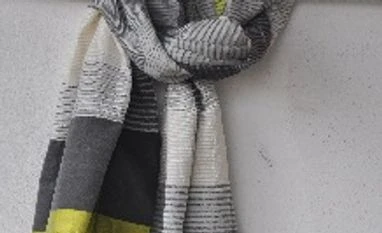
In the past 40 years, Holkar has not only helped create innovative fabrics but has also generated employment for 17 million weavers across India by resuscitating looms. “The biggest challenge has been to make weavers overcome the fear of change,” she says. Her efforts to bring the languishing Maheshwari silk back into mainstream weaving with REHWA, an NGO she started in 1978, is laudatory. “We contemporarised the conventional Maheshwari sari, and changed the colour story from a vibrant marigold and emerald green to a subtler hue. We also blended in tussar, silk and wool, thus creating a heady cocktail,” she explains at the Heritage of Style India exhibition that has been organised jointly by Hirumchi Styling Co and her.
Holkar didn’t just weave castles in the air. She based her work on the history of the Maheshwari silk. She realised that during Rani Ahilyabai’s reign, the saris didn’t have figurative borders but geometric ones. Holkar felt that borders shouldn’t be limited just to the edges of the saris but could be placed elsewhere on the fabric as well. Her innovations found patrons in MF Husain and Muzaffar Ali. The latter sourced most of his weaves from her for his film Umrao Jaan.
(From left to right) Sally Holkar, founder, Women Weave and Geeta Khanna, founder, Hirumchi Styling Co.
“During the princely era, the Maheshwari was made from pure cotton. But after independence, it became difficult to source the high quality raw material required for the weave,” she says. “Earlier the zari used to come from France and the dyes from Germany. When the privy purses were discontinued, the weavers no longer received patronage from the maharajas, and thus we saw an onslaught of chiffons.” Chinese silk, cotton from Coimbatore and zari from Gujarat began to be used in the sari. “When I got married, weavers appealed to us, and with a grant of Rs 88,000 from the Indian Central Welfare Board, we began a small initiative that has mushroomed into a movement today,” says Holkar.
She also began to employ marginalised women who worked in brick kilns and mines and taught 100 of them how to spin khadi on semi-automatic Amba charkhas, bought from Gujarat in 2002. And thus the WomenWeave Charitable Trust was born. She has trained weavers from Maheshwar, Chanderi, Dindori, Bhuj and Kota. “For instance, people from Madhya Pradesh’s Baiga tribe were losing their traditional market due to the onslaught of synthetics. They had no electricity, water or means of communication with the outside world. But what they had was an expertise in weaving. We helped them create scarves with the help of designer Subroto Sadhu,” says Holkar. Today, they have bagged an order for 2,000 scarves for Calypso, a store in the US.
Contrary to popular belief, Holkar feels that the handloom is still valid in the modern world. “All we need to do is work in the hinterland and see how liberated the new generation of weavers is. But the sad part is that 17.8 million weavers in India are looking for quality intermediaries,” she says. To solve this problem, she has opened a school in Maheshwar for weavers in the age group of 17-20, where they are taught basic English and computer skills. “This was a tradition that flourished under a woman’s rule (Ahilyabai Holkar) 1,500 years ago and today it has been taken forward by a woman,” says Holkar.
-------------------------------------------------------------------------------------------------------------------------------------------------------------------------
Sally Holkar's saris will be exhibited at Apparao Galleries in Chennai between April 3 and 5

 "Weaving in a change")


 Connect with us on WhatsApp