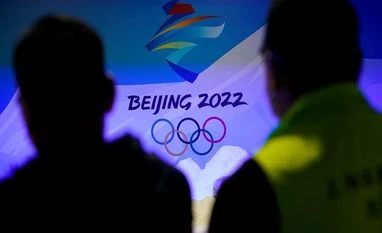
"(The Chinese) want sustainability to be the heart of how they prepare and host the Games," Marie Sallois, Director of Corporate and Sustainable Development at the International Olympics Committee, told Reuters.
The Beijing Winter Olympics Committee said in a pre-Games report in January that about 158,300 tonnes of emissions have been saved via deployment of low-carbon energy and venues.
Total greenhouses gases emissions could reach 1.028 million tonnes of carbon dioxide equivalent throughout the preparation and post-Beijing Games in 2016-2022, about a third less than the 1.6 million tonnes emitted for South Korea's Pyeongchang Games in 2018.
Most of that reduction comes from the absence of overseas spectators at the Beijing Games due to China's zero-COVID protocols. The lower number of international flights will mean 512,000 tonnes of CO2 emissions less than earlier projections, the committee said.
WASTE COOLED RINKS
China, for the first time at an Olympics, is using CO2 collected from industrial waste gases to cool ice rinks in its four ice sports venues, replacing traditional hydrofluorocarbons that can damage the ozone layer.
The 25 games venues, of which 13 were newly built, have also deployed energy-saving technologies, including low-carbon building materials such as recycled cement and smart snowmaking, which could use 20% less water than traditional technologies.
China is the world's largest hydrogen producer, with annual production capacity of 41 million tonnes, and has been striving to make technology breakthroughs in storage and transporting the clean energy.
Still, criticism over pollution, water usage and the ecological sustainability of the Beijing Games has persisted, especially over the need for 100% artificial snowmaking, which puts pressure on regions with already strained water resources.
Olympics toward dry countries with limited snow, requiring extensive, carbon-intensive infrastructure.
One subscription. Two world-class reads.
Already subscribed? Log in
Subscribe to read the full story →
Smart Quarterly
₹900
3 Months
₹300/Month
Smart Essential
₹2,700
1 Year
₹225/Month
Super Saver
₹3,900
2 Years
₹162/Month
Renews automatically, cancel anytime
Here’s what’s included in our digital subscription plans
Exclusive premium stories online
Over 30 premium stories daily, handpicked by our editors


Complimentary Access to The New York Times
News, Games, Cooking, Audio, Wirecutter & The Athletic
Business Standard Epaper
Digital replica of our daily newspaper — with options to read, save, and share


Curated Newsletters
Insights on markets, finance, politics, tech, and more delivered to your inbox
Market Analysis & Investment Insights
In-depth market analysis & insights with access to The Smart Investor


Archives
Repository of articles and publications dating back to 1997
Ad-free Reading
Uninterrupted reading experience with no advertisements


Seamless Access Across All Devices
Access Business Standard across devices — mobile, tablet, or PC, via web or app
)