Women cricketers chase cup glory and a level playing field

India, the runners up from the previous edition - losing to hosts England in a tensely fought final at Lords - kick-start their campaign on Sunday morning after two years of obscurity.

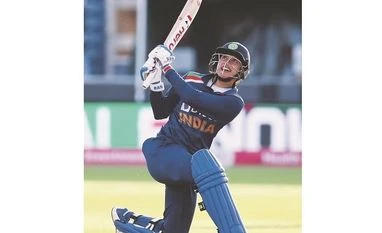
Smriti Mandhana
Smriti Mandhana
Vaibhav Raghunandan New Delhi
7 min read Last Updated : Mar 05 2022 | 12:01 AM IST
“Let’s show them,” the big boards say. Three words, defining the ICC Women’s Cricket World Cup that kicked off on Friday — almost exactly 13 months after its postponement due to the pandemic. If you don’t know, now you do. India, the runners up from the previous edition — losing to hosts England in a tensely fought final at Lords — kick-start their campaign on Sunday morning after two years of obscurity.

That final, in 2017, was supposed to be the women’s game “coming of age” in India. An age of glorious misses, upsets, triumph of hope over expectation. Because expecting anything is antithetical to women’s sport in the country. This “coming of age” rolled on to the Women’s T20 World Cup in 2020 — again India made the final and yet again they went down to the hosts, Australia, trounced this time rather than pipped at the post.

That final was played on March 8, 2020, exactly a fortnight before the curfew that announced the docking of the pandemic on Indian shores. Almost immediately global sport went into shutdown, before lucrative men’s sport slowly resumed. The women disappeared from public consciousness.

The statistics make you cringe. In the one year from that final (one International Women’s Day to the next, ironically) the Indian women’s team played exactly one fixture, a T20I against South Africa — an abject eight wicket loss where they looked overcooked and underprepared. The men, in contrast, played eight Tests, three ODIs and 3 T20Is within the same period. Discount internationals and Indian women cricketers were left sitting at home, while their men counterparts played the IPL in a foreign country, the Board of Control for Cricket in India (BCCI) jumping through hoops to ensure the piñata with the money bags stayed afloat. There is no women’s IPL yet — the Jio Women’s T20 Challenge, conceived after the 2017 World Cup, has been held three times, and wasn’t held in 2021, citing the pandemic. The three-team event is more patronising than promoting, a showpiece held between the men’s IPL playoffs.

“Even if you count that, it’s not enough,” a former national team player says under condition of anonymity. “There’s no concrete domestic structure, no clubs that can ensure a steady stream of players coming through. It’s all a bit ad-hoc. Girls are supposed to work hard on their own. And we have…”

In 2017, speaking to the media, former Test captain Diana Edulji, then a member of the Supreme Court-appointed Committee of Administrators for the BCCI, called the board a “male chauvinist organisation”. It’s been five years and it’s tough to shake off the feeling that much has changed. Consider the words of the current BCCI president when asked what plans were in place for a women’s IPL. “Hopefully in the future, we will be able to host a bigger women’s IPL,” Sourav Ganguly told <Sportstar>, “once the number of women’s players goes up.” How that will happen without any incentive of money, tournament time, game time or experience, is a question worth asking.

Even at an individual level, sponsorships and TV time for the biggest names in the country are tough to come by. Smriti Mandhana is the current ICC Women’s Cricketer of the Year, but her brand mileage is nowhere near that of the newest members of the men’s team. The BCCI’s jersey contract with Byju’s extends to the women’s team, too, but the difference in player pay is devastatingly stark. In May last year, the BCCI announced its annual player contracts for women cricketers (<see box>). Split over three slabs, they ranged from Rs 10 lakh to Rs 50 lakh. The men’s contracts are split over four slabs, ranging from Rs 1 crore to Rs 7 crore. Which basically means Mandhana, one of those in the “A Category” earns half that of a male contemporary in the lowest category.

The argument against equal pay always boils down to commercial viability. In a game like cricket, and in a country like India, this becomes even more pronounced — why pay equal salaries when you can’t pull equal eyeballs at all. The problem with this linear thought, though, is the lack of foresight and an inability to glean potential.

“Indian women’s cricket is clearly rising,” the former player says. “It would be a great time for everyone to act. I’m not just saying the board should, but also others. More investment, more clubs, more teams, more ads for the games… if the fans ask, then the board has to do it.” The world certainly seems to think so. Australia and England have pushed forward with women’s cricket at the forefront of the agenda. Australia’s Women’s Big Bash League (WBBL) is quite possibly the epochal T20 competition in their game. And curiously enough, while the BCCI does not allow its men to go play in any international T20 leagues, the women can, and have. Harmanpreet Kaur, India’s T20I captain, was the Most Valuable Player at the most recent edition of the WBBL. Smriti Mandhana equalled the highest recorded score in a game at the event.

After the event, speaking to the media, Kaur reluctantly and cautiously hoped to get a similar league for and from her own compatriots. “As cricketers, we always want to play as many games as possible,” she said, before hoping for the addition of a women’s IPL to the calendar. “I think this is something we are really waiting for.”


In the midst of all this apathy, India will launch their World Cup campaign, against who else but... Pakistan. “Let’s show them” is what the ICC’s billboards say, when perhaps it would have perhaps been more on point to say “Are you watching?” Since March last year, the preparations have been focussed on this one tournament — the team has played 16 ODIs over the past year. While the men’s version of the same fixture is precluded by ads in bad taste, Twitter barbs and an exciting and often toxic build-up, for the women’s version there’s complete silence, compounded perhaps by the fact that the Indian girls are considered huge favourites. Even if the stats themselves wouldn’t say so; both teams have won three of their last 10 ODIs although, arguably, the Indian women’s team have played tougher opposition.

“For women cricketers, it’s always a fight for survival,” former cricketer and journalist Isabelle Westbury said. “If men stand up and ask for more, then they’re hailed as leaders but if the women do it, they’re angry dissenters.”

In the context of all of this, India’s women cricketers are probably paying more attention to the words from Gin Wigmore’s World Cup anthem itself. “I run, run the high road, I’m back taking my throne. I know the patriarch don’t fit the part, what I’m gonna start.”

Backing up

The BCCI’s jersey sponsorship deal was one of the items on the agenda for discussion when its apex council met on March 2. Details from the meeting have not yet been released publicly, but it is well known that Byju’s, the current sponsor, will see their deal expire at the end of the month. Byju’s has reportedly expressed an interest to renew the deal. The edtech firm stepped in as sponsor after Oppo pulled out of the deal in 2019, with almost two years of the contract yet to run through. Oppo had been signed on to pay Rs 1,079 crore (double the base price quoted by the board) over a five-year period. Byju’s took over the same contract and paid the BCCI Rs 4.5 crore per match in bilateral series, and Rs 1.56 crore for an ICC tournament.


One subscription. Two world-class reads.

Already subscribed? Log in

Subscribe to read the full story →
*Subscribe to Business Standard digital and get complimentary access to The New York Times

Smart Quarterly

₹900

3 Months

₹300/Month

SAVE 25%

Smart Essential

₹2,700

1 Year

₹225/Month

SAVE 46%
*Complimentary New York Times access for the 2nd year will be given after 12 months

Super Saver

₹3,900

2 Years

₹162/Month

Subscribe

Renews automatically, cancel anytime

Here’s what’s included in our digital subscription plans

Exclusive premium stories online

  • Over 30 premium stories daily, handpicked by our editors

Complimentary Access to The New York Times

  • News, Games, Cooking, Audio, Wirecutter & The Athletic

Business Standard Epaper

  • Digital replica of our daily newspaper — with options to read, save, and share

Curated Newsletters

  • Insights on markets, finance, politics, tech, and more delivered to your inbox

Market Analysis & Investment Insights

  • In-depth market analysis & insights with access to The Smart Investor

Archives

  • Repository of articles and publications dating back to 1997

Ad-free Reading

  • Uninterrupted reading experience with no advertisements

Seamless Access Across All Devices

  • Access Business Standard across devices — mobile, tablet, or PC, via web or app

Topics :Women cricket IndiaIndia cricket teamIndia England Series

Next Story




