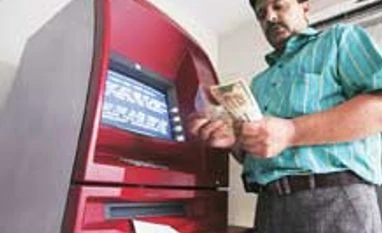
We take ATMs for granted, as agents of instant gratification, spitting out crisp notes that allow us to radiate a sense of confidence and security, even joy. What we don't expect these to be are repositories of innovation.
Yet, almost every ATM manufacturer has customised its machines in novel ways for the Indian market. "A solution for Europe or the US will not necessarily work in India," says Jaivinder Gill, Vice President, South Asia Pacific of global ATM manufacturer, NCR, which held a share of about 50 per cent of the Indian market last year. Gill says the Rs 1,550 crore the company booked in sales in FY12 was accounted for entirely by the machines its plant in Puducherry made and whose technology was devised by NCR's 700-member research & development centre in Hyderabad.
Not to be outdone, Diebold, another ATM giant, has brought out a machine it calls "the world's first intelligent-powered automated teller machine", it can automatically switch between using solar, AC grid or internal battery power. It's been designed for and made entirely in India.
These efforts are chasing the logic of numbers. A transformation is taking place across rural India where some 300 million people will soon be ushered into the banking system over the next few years. Already, some 80 million no-frills accounts with ATM cards have been created, thanks to banking correspondents working in the hinterland. And, many more will be, as payments for entitlement schemes such as the Mahatma Gandhi National Rural Employment Guarantee Scheme are made directly into bank accounts.
According to industry estimates, the current number of 1,20,000 ATMs would skyrocket to 4,00,000 in the next four years, substantially boosting the accessibility of these machines. Currently, India has an anaemic 74 ATMs per million people, against 300 per million in China.
Sensing an opportunity in these underwhelming figures some eight years ago, L Kannan, a mechanical engineer from the Indian Institute of Technology (IIT)-Madras, who was passionate about making relevant products for rural India, decided to partner the IIT-Madras faculty and crack the problem of devising a cheaper, 'rural' ATM. "They realised three hurdles would have to be overcome," says Vijay Babu, chief executive of Vortex, an ATM maker. "The ATM would have to be power-efficient, non-reliant on air-conditioning and able dispense crisp notes."
Vortex's solution: the Gramateller, rolled out last year. This uses a new, ingenious way of dispensing notes by placing the cassette containing cash on top and allowing gravity and motors to bring the notes down, into the cash slot; other ATMs use rubberised conveyor belts and springs to power the notes upwards. The machine can also withstand temperatures up to 50 degrees Celsius-perfect for scorching, rural locations that would melt the rubber inside more conventional ATMs, causing their notes to get stuck.
Consequently, Vortex's machines consume five times less power than a regular ATM (100 Watts, against 500 Watts) and don't need power-guzzling air-conditioners. Even better news: a price tag of Rs 1.5 lakh - 50 per cent cheaper than the competition
Ironically, the fundamental technology behind an ATM has remained unchanged in about 15 years. "These fourth-generation ATMs are still basically electromechanical devices," says Loney Antony, co-founder and chief executive of Prizm Payment Services, a payment solutions. Much of the innovation taking place is in the bells and whistles, added features and, therefore, functionality that transforms the capability of the machine. For instance, at its most basic level, most machines today come with UPS and batteries, a necessity in this power-starved country. At the other end of the spectrum are solar ATMs, of which Vortex is the largest vendor, having sold 300 of these.
International biggies seem to be taking a cue from Vortex's product development. NCR, having piloted three-four solar ATMs, says it would roll out its own line at some point. "Vortex led the way for NCR and Diebold to re-engineer their products," says Prizm's Antony. While that is impressive, the problem, says Antony, is that quick adoption of technology makes the ATM landscape a level-playing field until the next big idea comes along.
NCR's Gill says his company has innovated on the services side of things by having in-built diagnostic tools that can predict when parts wear out and cards get jammed-crucial for controlling operational costs, and a significant competitive advantage. His machines can also talk to the visually impaired and guide them through transactions. Also, bracing for the rural boom, almost every vendor's machine comes with biometric thumbprint scanners.
But there's the rub. Not every innovation, while intuitively a 'game changer', turns out to be one. Vortex's Vijay Babu says from the outset, most of their machines' biometric scanners were not being used. Thanks to the mobile revolution, rural customers were apparently able to effortlessly navigate screens; so, Vortex decided to put more emphasis on making the machine rugged. Also, solar ATMs may sound path-breaking, but these are costlier and only attractive for deployment in places that have no grid connection whatsoever.
ATMs may appear to have a stable future. After all, much work remains to bring the rural population into financial inclusiveness and cash hardly faces imminent extinction. That said, simple, mobile-connected swipe machines have swiftly made their way into the economy, as have rapid advances in mobile payment systems. Therefore, complacency in failing to constantly rethink the role of the ATM - say, as a wireless-enabled hub for e-commerce, or as an internet-enabled video-phone centre - could give the industry some nasty surprises.

 "ATM makers innovate to cash in on a boom")


 Connect with us on WhatsApp