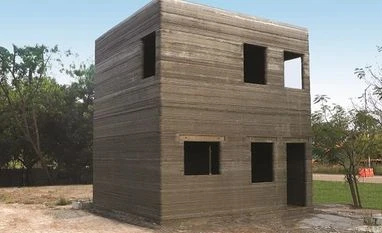
In a development that has the potential to disrupt the country's real estate space, L&T Construction has added muscle to its intent to leverage the latest technologies by entering the 3D construction space. The move co-incides with the Centre's plan to build about 60 million dwelling units in order to provide ‘Housing for All’ and meet burgeoning urbanisation requirements. L&T Construction essentially plans to build structures using 3D printed technology as it seeks make substantial improvement in speed and scale.
The company, which is the building and construction arm of the $21 billion technology, engineering & manufacturing conglomerate, Larsen & Toubro, has 3D printed a G+1 (Ground-plus-one) building with reinforcement for the first time in India.
3D concrete printing was identified as a potential game-changer for the construction industry. Since the technology was then yet at a nascent stage, a dedicated inhouse R&D team was tasked to study the feasibility of adopting it by evaluating aspects such as the right concrete mix, the most effective process & work methodologies, and such like.
“3D concrete printing is a technology disruptor with the potential to radically redefine construction methodologies...by demonstrating our growing expertise in 3D printing, we are well positioned to push the boundaries of automated robotic construction,” said M V Satish, whole time director & senior executive vice president (Buildings) at L&T.
He added that 3D printing will not only accelerate the pace of construction, but also significantly improve build quality.
The 3D challenge
The technology is predominantly used in various manufacturing industries to print rapid prototypes, complex shapes and small batch production using special polymers, metal alloys, and other material. 3D printing with concrete is, however, a completely different ball game and requires comprehensive knowledge and control of the 3Ms (Material, Methodology and Methods) for successful large-scale, accelerated operations. The technology can be a resounding success if it is able to perfectly synergise the 3Ms and seamlessly integrate them into the system.
In manufacturing industries, 3D printing is executed in a controlled environment, where factors like ambient temperature, moisture, humidity, and dust are tightly controlled. However, in the construction space, most projects are executed in an open-sky environment, where control over these variables is much more difficult and requires setting up of appropriate systems and processes for best results.
This single-storey 240 sq ft house was 3D-printed by L&T Construction in 2019
Getting the right mix
Satish says 3D concrete mix design requires a paradoxical combination of concrete properties to print successfully. The properties of 3D printable concrete are not straightforward as they involve various mandatories like maintaining sufficient ‘flowability’ till the concrete reaches the printer head. Once the concrete layer is printed, the structure must immediately gain sufficient hardness to retain its intended shape. It is also crucial to maintain green concrete status to ensure bonding between the layers, and yet gain sufficient hardening to take the load of subsequent layers. After various lab experiments and field trials, a perfect concrete mix design was arrived at that adequately met all the above properties.
To optimise the cost of constructing mass housing, it was strategically decided to use regular, locally available construction material for the mix design to produce at job sites, unlike the present industry practice of buying factory produced pre-packed mortar.
Integration of horizontal and vertical reinforcement during the printing process has been another challenge for which certain ingenious methodologies have been devised to embed the reinforcement and suitably modify the printhead to accommodate the revised printing methodologies.
The absence of conventional formwork systems and high design flexibility offered by 3D printing technology gives architects and design engineers the license to ‘imagineer’.
They can explore possibilities beyond the constraints of conventional formwork and execution methods. Innovative and fluid construction designs can be explored to enhance aesthetics, improve convenience, and optimise cost. Certainly, fully automated construction will accelerate the pace of execution and ensure high-build quality and safety.
Confirmming this, Manu Santhanam, Head, Department of Civil Engineering, IIT Madras, says, "3D printing of concrete enables the construction of structural elements without the need of formwork, which is able to reduce both cost and time. Further, the geometric flexibility afforded by this technology makes it possible to print difficult architectural features, which could be very cumbersome in a typical construction operation."
Santhanam explains that material wastage in 3D printing is also lower, as it is possible to optimise the deposition of material only in locations where needed. The integration of mechanical, electrical and plumbing requirements is also possible through an interface with other digital construction features.
L&T Construction's 3D printed building, which has a built-up area of 700 sq feet and is located at the company's Kanchipuram facility, has been erected with a special, in-house developed concrete mix using indigenously available regular construction materials. The building was printed with both vertical reinforcement bars and horizontal distributors using welded mesh, that satisfy provisions in the Indian Codes and optimise the cost of construction. Barring the horizontal slab members, the entire building structure was 3D printed ‘Cast in Situ’ at the job site in an ‘open to sky’ environment within 106 printing hours, using a fully automated 3D printer.
3D printing is a process in which the material is printed in a computer-controlled environment to build a 3-dimensional product, typically layer by layer. It is predominantly used in manufacturing industries to print rapid prototypes, complex shapes and small batch production using special polymers, metal alloys and other material. 3D printing with concrete is still largely work in progress across the globe.
Durability: Because of the high-quality materials used and the fully digital methodology, the quality of construction is expected to be excellent, leading to a good long-term performance, says Santhanam of IIT Madras. Since a number of 3D printing projects employ cavity wall construction, the weather-proofing of the structure against inclement weather is possible by inclusion of suitable insulating membranes in the cavity.
The road ahead
Earlier in November 2019, the team had 3D printed a 240 sq ft, 1-BHK apartment, in line with typical EWS (economically weaker section) building layout, to explore the feasibility of this innovative technology.
With the successful 3D printing of a G+1 building in accordance with the Indian CODAL provisions for such structures, L&T Construction has proved that the organization possesses the requisite expertise to leverage this futuristic technology.
However, being a new technology involving a fully automated construction methodology, there are still a few design validation processes to be completed, before taking to market that are being currently addressed through various Indian statutory bodies, research institutions, and the like. Both the 3D printed buildings will be used for such testing and validation.
3D concrete printing will completely change the dynamics and offerings of the affordable and mass housing industry. It will usher in a significant upward shift in safety, speed, scale, and superior designs. Architects will begin to play a more defining role to build fluid and building structures that can take aesthetics and convenience to the next level. Made-to-order houses are not too far away, said Satish.