Made in India handsets ring true, the hitch is in value addition

That's good saving in a country consuming 275 million mobile handsets a year. But that's only half a story
graph
Arnab Dutta New Delhi
Last Updated : Sep 22 2018 | 5:30 AM IST
Many got to click selfies with Prime Minister Narendra Modi on Thursday when he decided to take the airport-bound metro rail for an event in the capital. Soon after in his address, the PM referred to mobile handsets that made those selfies possible, pointing out how those phones are turning around the manufacturing fortunes of India. He said as 80 per cent of the mobile handsets were being manufactured in India, India was able to save around Rs 3 trillion in cell phone import bills during the last four years. 

That’s good saving in a country consuming 275 million mobile handsets a year. But that’s only half a story. 

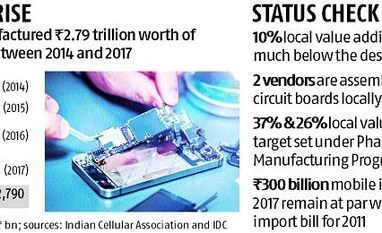
Data shows that between 2014 and 2017, manufacturing facilities in India produced handsets worth Rs 2.79 trillion. In addition, the import of finished handsets had fallen to 60 million units in 2017 from 190 million in 2014. But, what is commonly referred to as local manufacturing often boils down to assembling of imported components in an India-based factory.      

In fact, the level of value addition made locally — a measure of on ground progress in reduction of imports for a country — remains below par, even when compared to the government’s own Phased Manufacturing Programme (PMP) targets, analysts said.

Industry estimates suggest that the extent of value addition in the handset space remains at a mere 10 per cent. That effectively means, value-wise 90 per cent of all components used in making a handset continues to be imported. Take the selfie camera, for instance, in a smartphone. The front cameras are totally imported from countries such as China, Vietnam and Taiwan. Put together, the front and real camera of a handset constitute close to eight per cent of a handset’s cost, a company executive pointed out. 

According to the PMP announced last year, by 2018-19 companies were supposed to begin  sub-assembling a bunch of sophisticated components like camera modules, printed circuit boards (PCB) and connectors. However, none has expressed interest in making camera modules here.

“There is no denying that the number of brands manufacturing in India has grown. But the challenge remains in value addition,” said senior industry analyst Faisal Kawoosa, who now leads research and consulting firm TechArc. 

According to India Cellular Association, the size of mobile handsets market stood at Rs 1.56 trillion in 2017. But the industry is far from meeting the PMP goals — 26 per cent local value addition for smartphones and 37 per cent for feature phones by March 2020. Currently, the extent of value addition in feature phones stand at 15 per cent — thanks to manufacturers shifting production of low-value components like batteries and chargers to India.

Only Samsung and Xiaomi — the two smartphone majors –— assemble PCBs here. While, Samsung began in a small scale in 2007, Xiaomi started PCB assembly at its units with Foxconn more recently. Companies that Business Standard spoke to said they had no immediate plans for other complex parts like camera modules and display panels (that form 17 per cent of total value). PCBs, which cost over 50 per cent of a handset, are only being assembled here, industry representatives said. 

“Some of the companies have already begun assembling PCBs. While it may take more time than estimated, eventually more companies will join in. Already 90 per cent of them are assembling phones here,” said Jaipal Singh, analyst with IDC. 

Two big players Vivo and Oppo, which now hold the third and fourth spots respectively in the smartphone market, behind Samsung and Xiaomi, also have plans to start assembling PCBs in India soon. Both are willing to set up plant in Noida to start complete knocked down level manufacturing. Vivo has set aside Rs 3 billion and Oppo plans to invest Rs 22 billion.

Meanwhile, a falling rupee is eroding the benefits so far earned from the 120-odd assembly units set up in India by various vendors as components continue to be imported. According to Kawoosa, the fluctuating rupee-dollar exchange rate is only offsetting the benefits that the industry was going to accrue. “The government has to work on improving the rupee value to take Make in India to the next level, where the focus is more on value rather than growing volumes,” he said.

One subscription. Two world-class reads.

Already subscribed? Log in

Subscribe to read the full story →
*Subscribe to Business Standard digital and get complimentary access to The New York Times

Smart Quarterly

₹900

3 Months

₹300/Month

SAVE 25%

Smart Essential

₹2,700

1 Year

₹225/Month

SAVE 46%
*Complimentary New York Times access for the 2nd year will be given after 12 months

Super Saver

₹3,900

2 Years

₹162/Month

Subscribe

Renews automatically, cancel anytime

Here’s what’s included in our digital subscription plans

Exclusive premium stories online

  • Over 30 premium stories daily, handpicked by our editors

Complimentary Access to The New York Times

  • News, Games, Cooking, Audio, Wirecutter & The Athletic

Business Standard Epaper

  • Digital replica of our daily newspaper — with options to read, save, and share

Curated Newsletters

  • Insights on markets, finance, politics, tech, and more delivered to your inbox

Market Analysis & Investment Insights

  • In-depth market analysis & insights with access to The Smart Investor

Archives

  • Repository of articles and publications dating back to 1997

Ad-free Reading

  • Uninterrupted reading experience with no advertisements

Seamless Access Across All Devices

  • Access Business Standard across devices — mobile, tablet, or PC, via web or app

Next Story



